1.2 Animal welfare status
Any farmed aquatic animal is required to be reared in conditions that present as many positive experiences as possible over the course of its life history, that would translate to a "good" welfare status. This welfare status, however, is dynamic and depends on both internal factors of the animal and external factors surrounding the animal that are explored in this section
Internal factors consist of naturally occurring or induced functional imbalances / disruptions (e.g., nutritional, environmental, and health domains), and give rise to survival-critical experiences (e.g., suffocation, hunger, pain, sickness) that motivate animals to engage in behaviours aimed at securing life sustaining resources (e.g., dissolved oxygen, food, shelter) or minimising life-threatening situations (e.g., injuries, lack of dissolved oxygen, infections). 'Survival-critical' experiences are negative, and their intensity tend to range from very negative to neutral (Fig. 1.1). External factors give rise to context-specific experiences, ranging from strongly negative to strongly positive. These can include:
- Animal perceptions of the levels of threat (low to high), or degrees of stimulation (either pleasurable or under-stimulating).
- Restrictions or ease of movement.
- Social isolation or opportunities for companion interactions (e.g., behaviour domain).
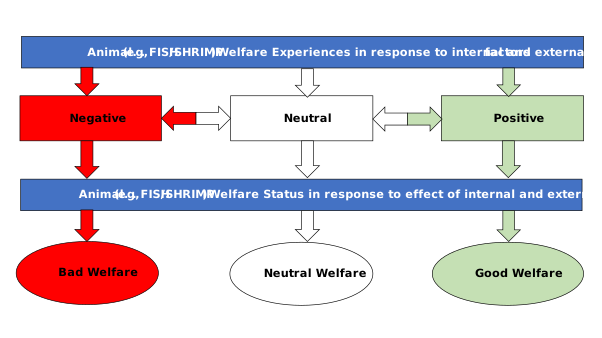
Figure 1.1: Welfare status of an animal (e.g. Fish/Shrimp) depends on the experience (negative to positive) it has in response to the effect of internal and external factors (source: authors)A text-based diagram indicating welfare can be in a continuum from negative through neutral to positive depending on different factors. It has a long box at the top representing an animal's welfare experience in response to internal and external factors. Three arrows come down from this to boxes (from left to right) marked Negative, Neutral and Positive. Arrows downward from these lead to another horizontal box which represents an animal's welfare state in response to the effect of the internal and external factors. Downward arrows from this box leads to separate text shapes from left to right labelled Bad welfare, Neutral welfare and Good welfare.
For example, a fish or shrimp that requires environmental enrichment (e.g. natural/artificial substrates) will only show positive welfare experience and good welfare status if the appropriate substrates are set up in the tank or pond. Adoption of non-ablation in shrimp hatcheries has been identified as a high welfare practice due to its positive effect on welfare of the shrimp broodstock and their offspring which is translated in low stress and susceptibility to diseases.
Overall, maintaining a good animal welfare status during the production cycle benefits the farm and can reduce the disease risk incidence and improve production or productivity which can lead to some economic benefits. Furthermore, improving welfare of animal before stunning and slaughter can increase product quality. Finally, providing good animal welfare can reduce public concerns (e.g., consumers, NGOs, Certifiers) and facilitate certification and improve access to markets.