3.1 Introduction
To assess an animal's welfare, a range of welfare indicators (WIs) must be established. WIs provide some form of quantitative or qualitative information on different aspects of the animals' welfare. As outlined in module 2, many welfare factors / challenges are applicable to all rearing systems. Likewise, there are certain WIs that can be used in most, if not all, rearing systems. Conversely, certain WIs are very specific to a production system or set of systems.
The following video provides a short introduction to operational Indicators (OWIs). It was prepared for a workshop at Dong Thap Community College in September 2024 based on work that was underway to develop OWIs for pangasis farming. In this case they are limited to a few direct physical indicators.
Download text transcript of video
Assessments of terrestrial and aquatic animals differ fundamentally, with the aquaculture setting presenting unique practical challenges due to its heterogeneous 3-dimensional aquatic environment. Differences in freshwater and seawater systems alone influence the significance of certain risk factors and, consequently, the relevance of certain indicators.
A clear example of this is the importance of certain water quality (WQ) parameters, across different husbandry systems. Open systems (e.g., ponds / lakes) tend to be faced with far more external water quality concerns, whereas closed systems (e.g., recirculating tanks) are often more concerned with system-driven challenges (e.g., equipment maintenance). Certain WQ parameters, however, should be continuously monitored regardless of the system involved (e.g., temperature and oxygen).
The 3D aquatic environment limits visibility at the surface level, unless aided with monitoring equipment / sampling events. This adds challenges for ID'ing and tracking individuals, particularly in farms with 100,000's of animals. High stocking densities add further logistical challenges to this monitoring / assessment task.
The significant variety of concerns and practical challenges presented within aquaculture settings contribute to welfare assessments and their associated WIs being so highly context-dependent. Careful selection of WIs is essential, as no single WI can cover all relevant aspects of husbandry systems, farmed species, and their specific needs (See Figure 3.1 below from Stien et. al. 2020). Reliable, accurate assessments of farmed animal welfare require a collection of species-specific (and sometimes, even system-specific) WIs that collectively provide a comprehensive evaluation.
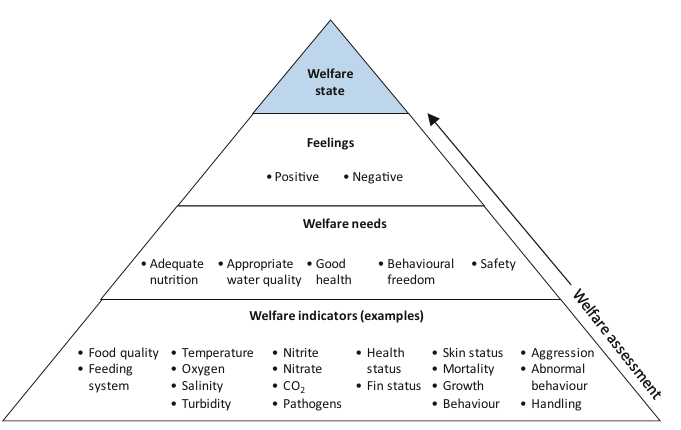 Figure 3.1: Conceptual diagram of how welfare indicators can be matched against welfare needs to provide insights into the animals' positive or negative emotional states, from which the welfare status of the animals can be inferred. The image shows an alternative outlook on the purpose of WIs (base of the pyramid), in which a collective use of welfare indicators help describe the degree of fulfillment of the welfare needs for a given species and life stage under the "prevailing" farming conditions. This degree of fulfillment in turn helps provide a description / insight into the extent to which the animal(s) are likely experiencing either positive or negative emotional states / "feelings". From this, varying conclusions can be made on the current welfare state of the animal(s) based on the collective data recorded from the various WIs involved. The image shows a pyramid (equilateral triangle) split horizontally into four sections. The top section at the peak of the pyramid is shaded and labelled "Welfare state". The section below is labelled "Feelings" which can be positive or negative. The section below that is labelled "Welfare needs" and mainly includes the five welfare domains. The bottom section of the pyramid is labelled "Welfare indicators" and gives a wide range of examples from feed, water quality parameters, health indicators, behaviour and handling. On the right side of the pyramid there is an arrow from the bottom to the top labelled "Welfare assessment". (from Stien et al., 2020)
WIs can be categorised in a number of ways, including by how directly they assess an animal's welfare (Direct, animal-based vs. indirect, risk-based indicators), and by how practical they are for on-farm use (e.g., Operational vs Laboratory welfare indicators - OWIs vs. LABWIs). WIs can even be further classified by the degree of labour and time required to carry them out on-site (e.g., passive/automated vs. manual OWIs), and by whether they capture data on an individual's welfare status or that of a whole group.
Below is a table outlining key groups under which WIs can be placed:
|
Welfare indicators by subject of assessment |
|
|
Type of welfare indicator |
Description |
|
Direct, animal-based (outcome) indicators |
Observations made on either physiological, morphological, or behavioural parameters of the animal itself. These are typically output-based (i.e., reflecting the outcome of important welfare aspects). A "poor score" indicates that a direct impact on an animal's welfare has occurred. |
|
Indirect, risk-based (resource) indicators |
Observations made on the surrounding environment, particularly any risks / benefits they pose for the animal(s) of interest. This includes rearing conditions, husbandry practices / staff training, and other abiotic / biotic risks. These are typically input-based (i.e., reflecting factors that potentially impact aspects of welfare). A "poor score" would indicate an increased risk has been posed to welfare. |
|
Welfare indicators by practicality for on-farm use |
|
|
Type of welfare indicator |
Description |
|
Operational Welfare Indicators (OWIs) |
Welfare indicators that are feasible enough for farm staff to readily use on any applicable farm site. More relevant for farmers, transporters, retailers etc., owing to their ease of integrating their use into routine husbandry practices. |
|
Laboratory Welfare Indicators (LABWIs) |
Welfare indicators that either require access to analytical facilities for their measurement or off-site specialist equipment to provide in-depth information to certain parameters of the animal. More relevant for research work, particularly under controlled environments |
|
Operational feasibility score (FISHWELL Handbook) |
Scoring system used to describe operational feasibility of WIs, based on sampling & analytical considerations. 1 = Readily usable on-site by anyone, 2 = usable on-site but requires expertise and / or further data analysis / specialist equipment, 3 = Can be sampled on-site but must be sampled in a laboratory, 4 = Either incapable of being sampled on-site, or currently requires extended periods of analysis in a laboratory. Put simply, 1 = Passive/Automated OWI, 2 = Manual OWI, 3-4 = LABWI |
This module will help outline the role(s) that these different WIs can fulfil under the aforementioned categories. See a longer introduction to operational welfare indicators in fish in the following video:
NB: This third-party video is linked for illustration only and copyright and control belong entirely to the originating organisation