3.4 Risk-based (resource) indicators
Risk-based indicators compliment animal-based indicators in that they are concerned with identifying and reducing factors which might compromise the welfare of the stock. They can be used to help design better farming systems, improve welfare monitoring and are particularly used in farm certification programmes.
Purpose of risk-based indicators
Indirect, risk-based indicators are often regarded as precautionary tools, designed to predict and prevent potential issues before they can arise. In essence, these indicators are "inputs", typically signaling the presence or absence of risks, or represent measures implemented to mitigate those risks. As a result, many of these indicators are evaluated in terms of whether or not they reach an acceptable threshold of risk mitigation. Consequently, many risk-based OWIs are assessed using a simple 'yes' or 'no' approach to determine if the necessary risk mitigations are in place. However, certain environmental indicators (e.g., WQ parameters, temperature, O2, pH etc.) are evaluated on continuous scales, similar to many animal-based indicators.
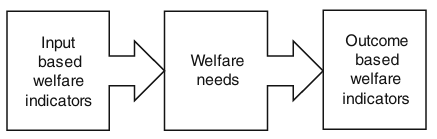 Fig 3.4: Simplified illustration of the relationship between risk-based ("input") WIs and animal-based ("outcome") WIs (Source: Stien et al., 2020). Flow diagram with three cells linked by arrows starting with input based WIs then welfare needs then outcome indicators. This shows the relationship between risk-based ("input") WIs and animal-based ("outcome") WIs. The latter is more reflective of what has already occurred, whereas the former is more predictive, focusing on factors before issues manifest themselves.
Conversely, the previously listed examples of animal-based indicators tend to only capture problems after they have already occurred, and an animal's welfare has since been compromised (i.e., the best score possible for many animal-based OWIs is simply the absence of any issues, such as no damage or deterioration of a fin).
Clauses in welfare standards / certification schemes - unique application of OWIs:
There are numerous standards promoting more welfare-friendly aquaculture. Within these welfare standards / certification schemes, farmers commit to maintaining a strict set of requirements under a 'duty of care' for the animals they grow and sell. In return, the farmers are rewarded with a 'certification' (i.e., a unique label) that proves their commitment to farmed animal welfare. This provides the public, and potential consumers, with the assurance that a certain level of welfare has been achieved.
Depending on the certification scheme, their standards typically involve detailed, comprehensive, and species-specific requirements that cover many if not all of the welfare factors listed in Module 2 (presuming they are applicable to the farm being certified). Each requirement, otherwise known as a 'clause' within the standards, functions as its own type of OWI. This is because each clause is eventually assessed (or, 'audited') by the certifying parties on a regular basis to ensure that the farms are actually meeting these requirements. These audits are usually carried out on certified farm sites annually, where a 3rd party assessor (or 'auditor') visits the site and tests them for compliance. A farm site is 'in compliance' when it meets the requirements of each clause, and does not fail any important aspect of them.
For example, the 1st clause of the standards could involve requirements on the quality of fish feed: ">85% of protein derived from fish feed used on this farm must consist of fish meal from a reputable source".
The next clause could be specific to rearing conditions: "Stocking densities of RAS tanks must not exceed X kg / m3".
In the majority of such cases, as mentioned in the introduction to this section, these OWIs are typically recorded as "yes"/"no", "Compliant/"Non-compliant", "Fail/Pass". They are typically either a measure of how many risks are being posed vs. prevented, or a measure of how many welfare needs are being met for the farmed aquatic animals involved. Even evidence for staff training (e.g., on appropriate feeding routines, animal handling, disease management, interventions etc.), biosecurity measures, proper maintenance of on-farm equipment, and records for all of these processes, can all be assessed and consequently act as OWIs, as these are all factors that ultimately play a significant role in determining the state of welfare for these farmed aquatic animals.
Below is a link to the welfare standards currently in place for farmed Atlantic salmon under the RSPCA Assured scheme, one of the most comprehensive set of standards currently present for welfare:
https://www.rspcaassured.org.uk/farmed-animal-welfare/salmon-trout/
Examples of this approach to welfare assessment for tilapia and shrimp can be found in the British International Investment toolkit for investment fund managers on animal welfare. These are part of a comprehensive set of guidance relevant to companies and institutional investors aiming to either implement or appraise Environmental, Social and Governance (ESG) standards. For tilapia, twenty sets of performance indicators are rated as either "observed", "progressing" or "not observed". A spreadsheet workbook then displays a chart showing overall compliance with the guideline standards.
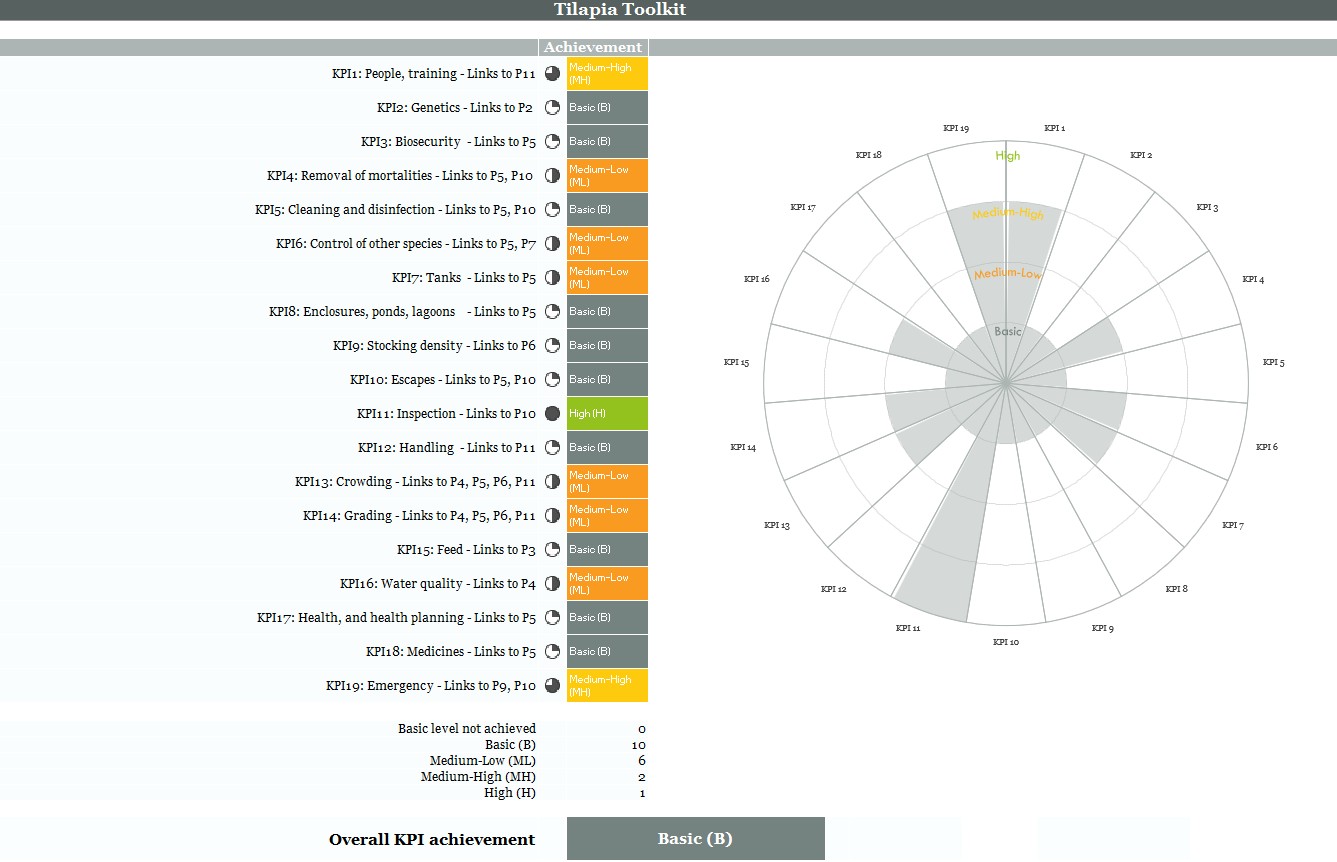 Figure 3.5: Example of output from BII tilapia welfare toolkit risk-based indicator assessment indicating level of compliance (basic, medium-low, medium-high or high) across 20 key performance indicator groups. This figure is generated by the British International Investment tilapia welfare toolkit spreadsheet. This requires the user to assess 142 indicators across twenty areas as either "observed", "progressing" or "not observed". These ratings are converted into numerical scores and displayed as a radar pie chart. The results of each indicator group are also displayed as a colour coded cell and partially completed pie. The aim is to provide a quick visual overview of progress made towards minimising the risk of poor tilapia welfare.