3.2 Physical health - Morphology and physiology
Animal-based WIs are outcome-based, reflecting an animal's current welfare status by capturing past changes. This section focuses on WIs that directly assess their physical health, outlining their relevance to specific welfare aspects and key sampling considerations. These indicators are either scored qualitatively using a rank-based system (often morphological OWIs), or on continuous scales (often physiological OWIs).
Morphological OWIs:
These OWIs often assess the structural integrity of the animal; issues here often reflect problems that can easily lead to other health & welfare consequences, such as increased risks of infection/parasitism, nervous system disorders, impaired feeding/swimming performances, increased likelihood of further injury and death.
External morphological OWIs:
Fin condition/damage: Can be scored by degrees of damage / erosion / splitting / thickening / malformation... As fins are living tissue, and directly impact swimming performance, damage to them not only represents a new route for infection but a direct impact on welfare.
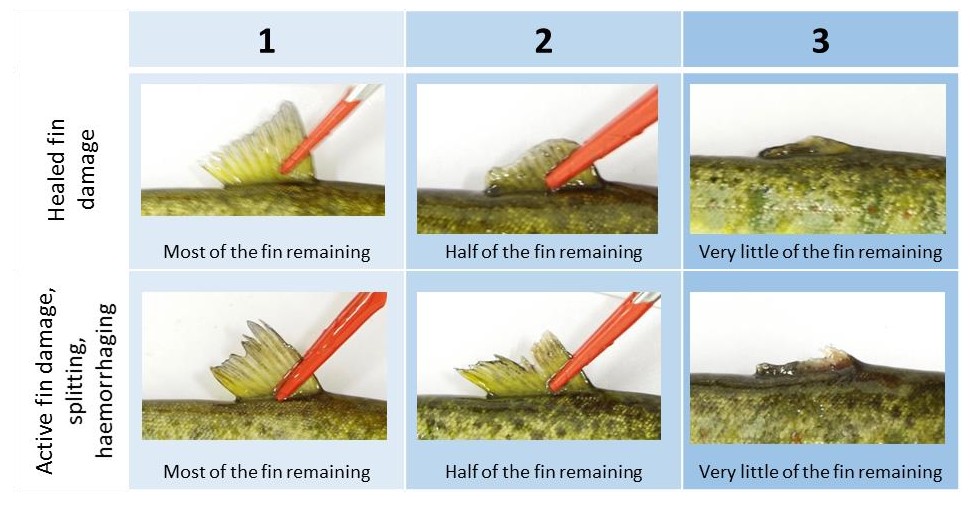 Figure 3.2: Example of a morphological scheme for classifying dorsal fin damage from Nobel et. al. 2018. Morphological scheme for diagnosing and classifying key external injuries to dorsal fins. Level 0: Little or no evidence of this OWI, i.e. normal (not illustrated). Level 1, minor to Level 3, clear evidence of the OWI. It is important to differentiate between healed lesions and active lesions. Active lesions indicate an ongoing problem that needs to be addressed. Link: https://www.hi.no/resources/forskningsgrupper--materiell/Fishwell-Welfare-Indicators-for-farmed-Atlantic-salmon-tools-for-assessing-fish-welfare.pdf
Skin condition or epidermal damage (scale/shell loss/damage, lesions, loss of mucus etc.): Skin, scales, and the mucus layer play an essential role in protecting against infections, and their absence / deterioration indicates increased susceptibility. Compromised immune system, osmoregulation, and likelihood of pain associated with damage to these living tissue layers are all why poor skin condition / open lesions have a marked effect on health and welfare.
Opercula condition: Plays a similarly important role as gills in respiration of certain aquatic animals. Root cause of such deformities relatively unknown (primarily attributed to nutritional deficiencies / poor environmental conditions). For fish, one of the primary purposes of opercula are to protect fragile gill filaments from physical damage; missing, shortened, or damaged opercula exposes the gills to significantly higher risks of external trauma and infections.
Eye condition (exophthalmia, haemorrhages, cataracts, etc.): While mechanical injuries (i.e., damage from handling) are typically of main concern here, eye issues can have numerous aetiologies. Exophthalmia is a common, non-specific sign of disease (where they eyes protrude outwards) across multiple species of aquatic animals that signals a disease issue that requires investigating further. Cataracts, where there is increased opacity of the lens, varies in severity to the point of irreversible damage / blindness.
Snout/Jaw condition: Can occur from improper handling procedures (e.g., during crowding, netting, or offloading at markets), or because of frequent contact against the edge / walls of their enclosure / tank.
Sampling considerations (For all external morphological OWIs above) - Any external injuries are immediate, obvious indications of poor welfare, and easy to observe during various procedures (or even from above water if clear enough). Sudden increases in injury frequency and severity are a quick, robust OWI for poor welfare and underlying issues that require further investigation. Qualitative assessments, either individually or as groups, can be carried out with minimal effort/impact to the fish, whereas quantitative assessments typically depend on manually sampling and handling (although this can still be carried out relatively rapidly on-site).
Active lesions / open wounds indicate an ongoing issue, whereas healed areas indicate historical / "old" damage. Exact relationships between the severity / type of damage direct impact on welfare difficult to ascertain. Often, these OWIs alone are insufficient to determine root cause of symptoms. Can also become time consuming to process individual OWI data to the point which farmers can act upon it. Samples must also be representative of the entire population; unless opportunistic sampling is taken, this can be time-consuming, labour intensive, and potentially disruptive to existing husbandry tasks.
Internal morphological OWIs:
Condition factor (K) / emaciation state: Condition factor is an OWI to provide a proxy on the nutritional health status of aquatic animals, typically fish. Calculated using K = 100 x Weight (g) x Length (cm)3, the higher the K value = 'rounder' the fish. Provides decent indication on the overall condition of the fish.
Sampling considerations - Difficult to define exact values for which welfare is compromised for many species, as various aquatic animals' condition factor can change significantly between different life stages / seasons. As an OWI, can be relatively non-invasive (simple measurements on anaesthetized fish), rapid, and inexpensive. However, effects usually have to be significant before issues are detected through this indicator.
Vertebral deformation: Abnormal spinal curvatures or damage can arise from injuries, malnutrition / poor water quality, or genetic disorders. Depending on severity, this can significantly impact swimming performance, swim bladders, and even the nervous system.
Sampling considerations - Number of classification/scoring systems developed for spinal deformations, typically categorically grading from no deformations (normal), to minor, to severe. A common and easy OWI used, unless x-ray use is required to detect minor issues and more accurate descriptions. Similar to gill conditions, issues in the spine can be caused by a range / combination of different factors.
Gill condition (bleaching / damage): This can be affected by poor water quality, parasites & bacterial/viral infections, other organisms (fungi & algal blooms), or even conspecifics. The importance of gill condition as an OWI stems from the fact that they are not only responsible for gas exchange (providing oxygen), but osmoregulation and excretion of nitrogenous waste. Furthermore, gill deterioration tends to make the fish even more susceptible to other disease.
Sampling considerations - Visual observations can be made to provide limited but cheap, effective observations on gill condition and the severity of any damage that may be present; scoring systems can be used categorically and qualitatively, providing an effective OWI on one of the most important organs of fish. Definitive evaluation, and diagnoses of any diseases, will require diagnostic services (most likely histological examination) beyond the typical OWI.
Physiological OWIs:
These OWIs assess the internal, functional health of the animal; issues here often reflect increased stress levels, malnutrition/metabolic imbalances, infections, hazardous environmental conditions etc... These issues can lead to further consequences, including organ dysfunction/failure, further impaired immune systems/growth, and increased mortality risks.
Blood parameters (Cortisol and Glucose levels): Cortisol secretion is a primary stress response, with circulating plasma levels thus serving as a proxy for stress. Despite its common use as an OWI, however, interpretation requires caution as both negative (stress) and positive (excitement) experiences can trigger this cortisol release. Furthermore, sampling methods required for obtaining cortisol is stressful itself, and improper handling and inefficient blood sampling can severely hinder the accuracy of results. Glucose is a secondary stress response, and used as a similar stress proxy. Similar considerations are required here. Increased glucose can provide this proxy of stress, but levels must be assessed on a relative basis (i.e., pre vs. post-stress), since various factors can influence plasma glucose.
Note, experimental work has also been carried out on assessing cortisol concentrations in culture water, skin mucus and fish scales. The former is completely non-invasive, and most likely to be useful in tanks with high stock densities and known water exchange rates. Fish scales are of interest as a potentially longer-term record of stress events, whilst mucus cortisol has potential as a less invasive measure.
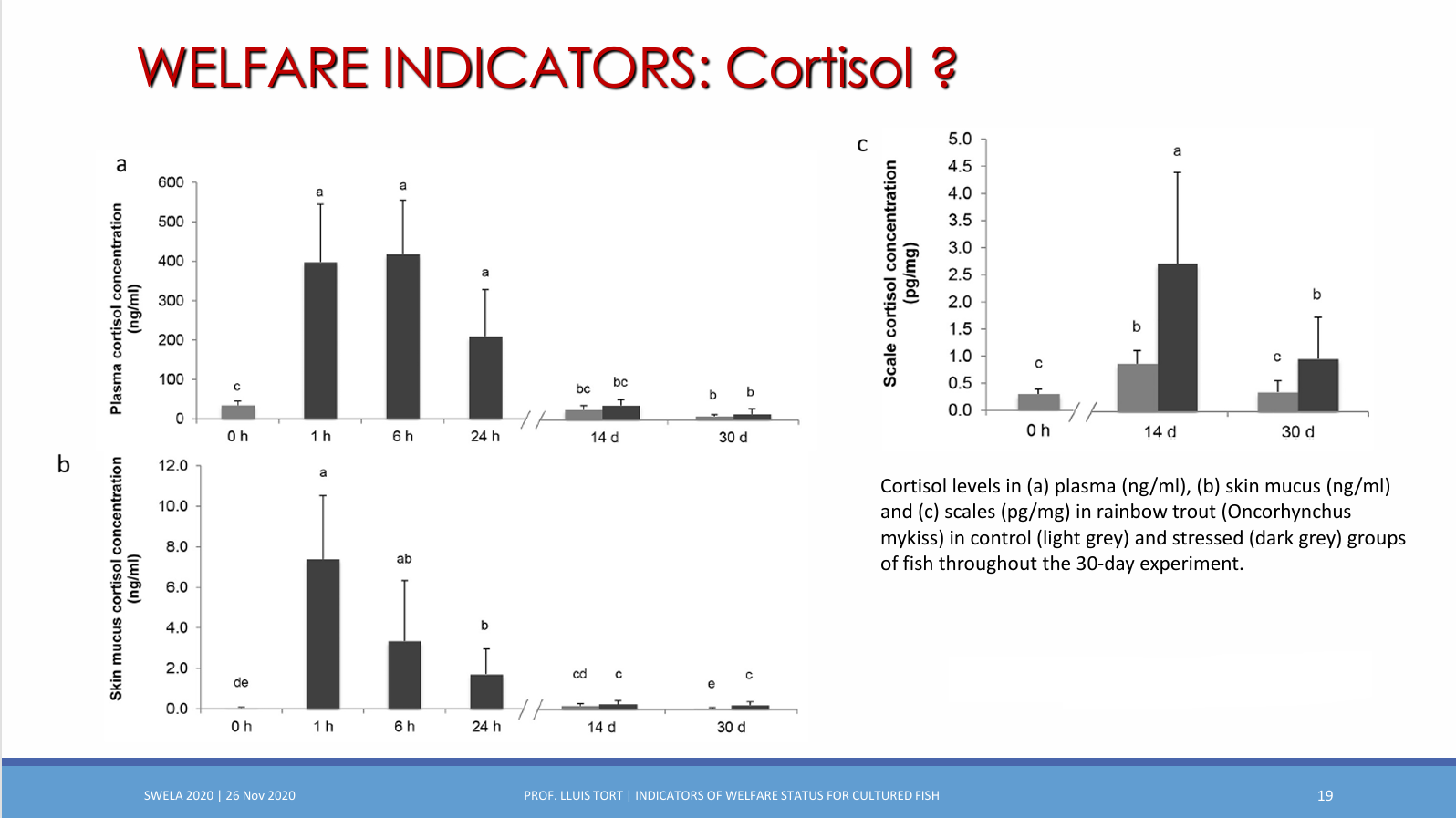 Figure 3.3: Example of research into cortisol concentration assays in blood plasma, skin mucus and scales following a stress event (Source: Tort, 2020) The three charts show how the concentrations of cortisol following a stress event change over 24 hours and then 14 to 30 days when measured in blood plasma, skin mucus and scales. Cortisol is least persistent in skin mucus and most persistent in scales. This slide is taken from a presentation by Prof. Lluis Tort which was part of the Second Symposium on Fish Welfare (Webinar) held in November 2020. A video of the full symposium is available on YouTube: https://youtu.be/kus_YXnPYDo?si=lD2o2_cFyvHGoZqh
Haematocrit levels- The level of red blood cells in the total blood volume are a key indicator of the animal's oxygen-carrying capacity, hydration status, and overall stress levels.
White blood cell count (WBC)- Elevated WBCs, leukocytosis, can be indicative of an infection or at least increased chronic stress levels, whereas excessively low counts, leukopenia, indicates immunosuppression. In either case, a deviation from the species' acceptable thresholds indicates the animal has been compromised.