2.1 Introduction
The vast diversity of farmed aquatic species prevents this course from covering species-specific welfare requirements in great detail for each species of interest. Regardless of the species being farmed, however, several key factors remain central to all fish farming practices. A high-level overview of the various aspects of aquaculture that can potentially influence fish welfare are outlined in the next few sections.
It is important to first recognise that the significance of each factor, and what impact(s) they may have on the overall welfare of the farmed fish, is also dependent on the scale and intensity of farming involved (i.e., whether intensive or extensive, subsistence or commercial farming). Furthermore, within species and even within strains / individuals, there is variation in how fishes might respond to these various factors.
These welfare factors (or ‘concerns) can be distinguished between those that are ‘ultimate’, and those that are ‘proximate’. ‘Ultimate’ concerns relate to aspects of physical health that are immediately essential for welfare and survival, such as respiration, nutrition, and body integrity. ‘Proximate’ concerns contribute moreso towards the long-term outcomes of an animal’s welfare state (i.e., it’s quality of life). Examples include the enabling of behaviours that improve body control or strength, or enabling exploratory or sheltering behaviours to provide better chances of finding food or resting. Certain factors are critical for the animal at all stages and thus require continuous oversight (e.g., feeding or respiration), whereas the importance of others (e.g., reproductive behaviours) may depend on a certain life stage.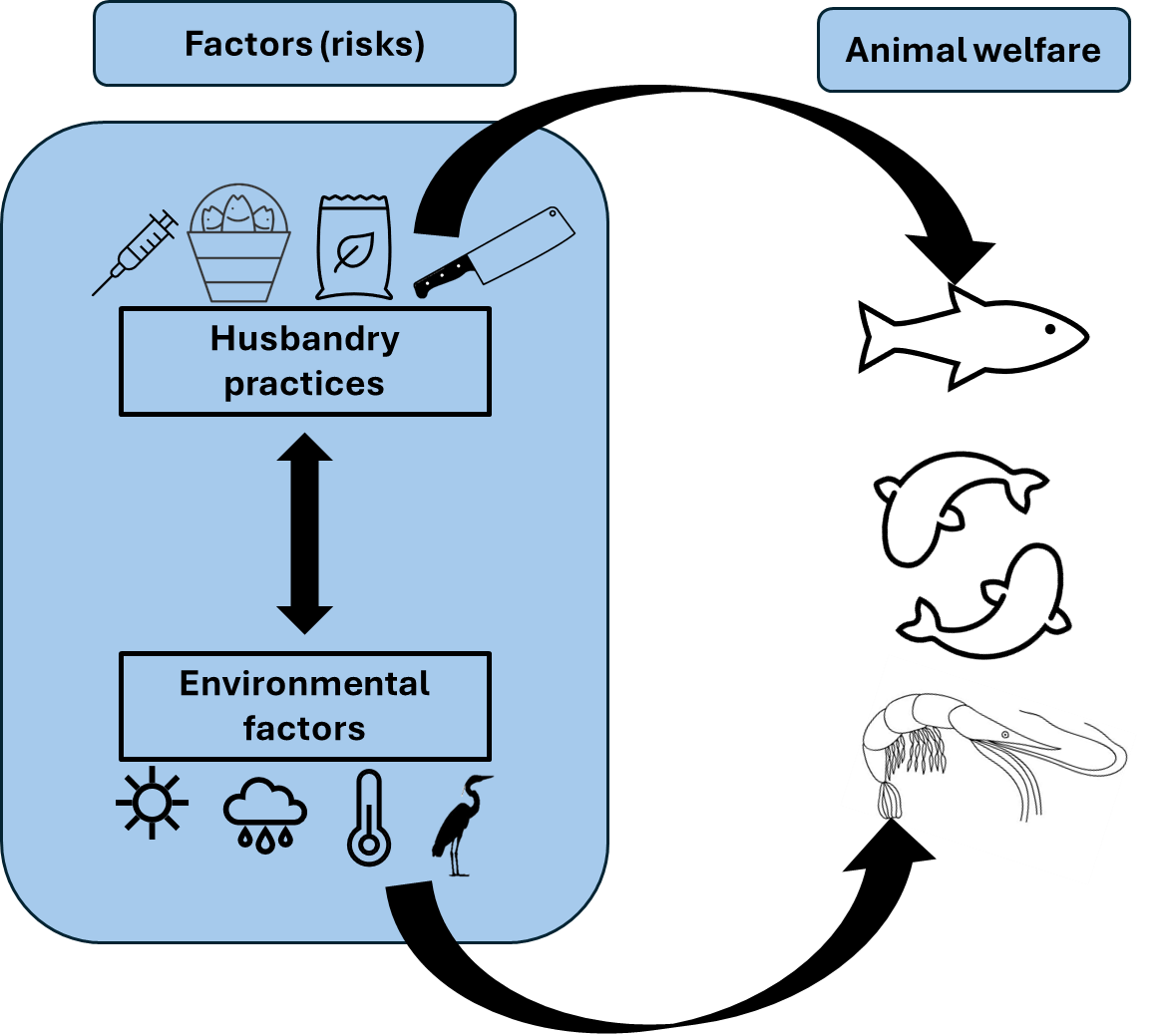 Figure 2.1: Conceptual diagram of risk identification with respect to animal welfare (source: Authors)The diagram shows risk factors on the left and animal welfare on the right. Animal welfare is represented simply by outlines of fish and shrimp. The risk factors have icons. The top group represent husbandry practices and have icons representing feed, transport, health and slaughter. The lower group represent environmental factors and include sun, rain, temperature and predators. A double ended arrow shows linkages between husbandry practices and environmental factors. Further arrows link the husbandry practices and the environmental factors animal welfare (the fish and shrimp images on the right).
The following video provides a short explanation of proximate vs ultimate factors:
NB: This third-party video is linked for illustration only and copyright and control belong entirely to the originating organisation