3.5 Environmental indicators
Aquatic animal welfare is heavily influenced by environmental conditions, with water quality parameters playing a complex but crucial role. The importance of environmental indicators lies in their associated factors directly impacting the physical health of aquatic animals in a myriad of ways. This section focuses primarily on environment-based OWIs, emphasizing the practical and logistical considerations in sampling them.
Environmental indicators are an indirect, but nevertheless valuable WI which are non-invasive and easy to monitor. Whilst mainly involving water quality parameters, other environmental parameters can be considered. Depending on each species and their evolutionary life histories (i.e., what environments they have evolved under and consequently are adaptable to, keeping in mind the concept of allostasis from Module 1), every aquatic animal's tolerance limits for these different environmental factors will vary. Empirical evidence on species-specific preferences and tolerance limits for key environmental factors (i.e., those listed in Module 2, such as temperature and oxygen) provide monitorable values for the indicator.
Further adding to this complexity, many environmental indicators interact with each other in subtle ways, and the extent of their effects are also dependent on the exposure time and state of each individual aquatic animal involved. For example, the impacts of abrupt changes in ambient water temperature is highly dependent on oxygen levels, feeding status, water currents, and of course the physiological and health status of the animals involved. As a result, defining precise limits for each WI - where animal welfare is protected or put at risk - can be challenging. Unless extreme levels are recorded, thus clearly indicating compromised health and welfare, the significance of many environmental WIs depends on the specific context and their interaction with other WIs.
This section, and the table below (Figure 3.6 adapted from Noble et. al., 2918) focuses on WIs that are operational, well-proven, and applicable in most farming situations.
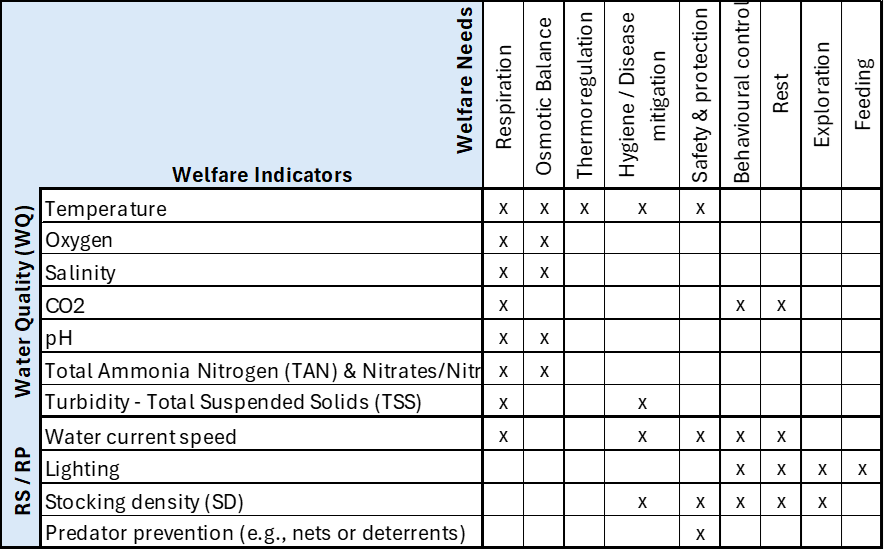 Figure 3.6: Table listing environmental-based WIs and what welfare needs each directly impacts. RS / RP = Rearing systems / rearing practices. Depending on the aquatic animal(s) involved, certain WIs may be less/more relevant The table shows a matrix with each row being a different welfare indicator and each column a welfare need. An "X" in the cell where each row and column intersect shows that the specific indicator and welfare need are related. Eg. salinity is a welfare indicator which is related to the welfare needs of respiration and osmotic balance, but not thermoregulation or feeding for instance. This table is modified from Noble et al., 2018.
Temperature: Many aquatic animals are poikilothermic = physiological and metabolic systems need to be well adapted to the temperature range they are exposed to. Temperature in particular affects numerous welfare factors, namely metabolism / respiration rates.
Sampling considerations: Depending on the stratification of the body of water involved, temperature can either be measured using a probe anywhere in the water (if well mixed) or measured throughout different depths to capture the range available to animals. Cheap & easy to measure, and affects many aspects of behaviour, welfare, and production parameters.
Oxygen: Metabolic rates and oxygen requirements of most aquatic animals increases with higher temperatures. As oxygen saturation declines = metabolic scope reduced = potentially severe impacts on welfare.
Sampling considerations: Similar to temperature, may vary within the body of water (in both space and time); measures should be taken when and where it is expected to be the lowest.
CO2: When CO2 dissolves in water it forms carbonic acid, and high levels of CO2 will reduce the pH of the water, especially if it has low alkalinity. Blood concentrations of CO2 are strongly correlated with water CO2, and increased levels can severely impact metabolic processes.
Sampling considerations - There are two main ways to measure CO2: 1) directly, using CO2 meters, or 2) indirectly, such as calculating it from pH and alkalinity (e.g. Moran et al., 2010). Blood concentrations of CO2 are strongly correlated with water CO2 and can provide information on physiological status of the fish, but irregular/singular measurements of CO2 can only provide a limited snapshot.
pH levels: High/Toxic H+ levels can severely impact osmoregulation and cause blood acidosis.
Sampling considerations - Measuring pH in water is a simple, easy process, achieved with various types of pH-meters. However, similar to measuring many of the WQ parameters listed here, it is essential that the probe involved is calibrated properly. Irregular or single measurements provide only a snapshot of the rearing systems, and pH levels can vary in space and time. Changes in pH alone is often insufficient for identifying specific problems. The pH scale is also logarithmic.
Total ammonia nitrogen (TAN): Temperature, pH, and salinity levels influence how much of the ammonia in a system ends up as ammonium. Ammonia has a toxic effect, detrimental in numerous ways. Although more toxic in salt water (due to higher pH levels), low water turnovers are more common in fresh water systems, where allowing concentrations of ammonia to be higher.
Sampling considerations - Ammonia commonly is measured using photometric methods, where substances are used to react with the ammonia and the resulting colour changes are measured. This should be monitored continuously either in systems with low water exchange, during transport, or where stocking densities are high.
Water current speed: Importance of this parameter depends on both the enclosure and species involved. Current speeds influence swimming performances of fish, water exchange and thus overall water quality (clearing of biofouling / waste).
Stocking density (SD): Typically expressed as kg / cubic meter, the ideal stocking density will vary greatly for each species of farmed aquatic animal. Furthermore, the "threshold" for ideal stocking density for each species will depend on other variables, such as WQ parameters, life stage, waste management practices, and rearing system. While this makes it challenging to define specific threshold, SD's direct relationship/impact on other WQ parameters means that it can, ultimately, significantly influence health and welfare of the animal(s) involved (albeit through indirect effects).
Sampling considerations - Easily calculated as biomass (kg) divided by the volume of water in the enclosure (m3). However, most farmed aquatic animals tend to be unevenly distributed in their enclosures, meaning "local" densities are often much higher than what can be calculated from this metric.