1.3 The Five Domains Model
Animal welfare status can be assessed based on the five domains which are also applied to aquatic farmed animals. Expressed in terms of compromises, they address more practically where issues arise with animal welfare. This section explores each of the five domains, and how they interact with each other to help form a larger understanding for what matters in animal welfare.
The five domains are: nutrition, environment, health, behaviour, and mental state. While the first four are predominantly physical/functional, the last (mental state) aims to represent the overall experience of the animal, i.e., its welfare status. It is through this approach that the five domains incorporates the aforementioned 'biological functioning' and 'affective state' approaches as assessable entities.
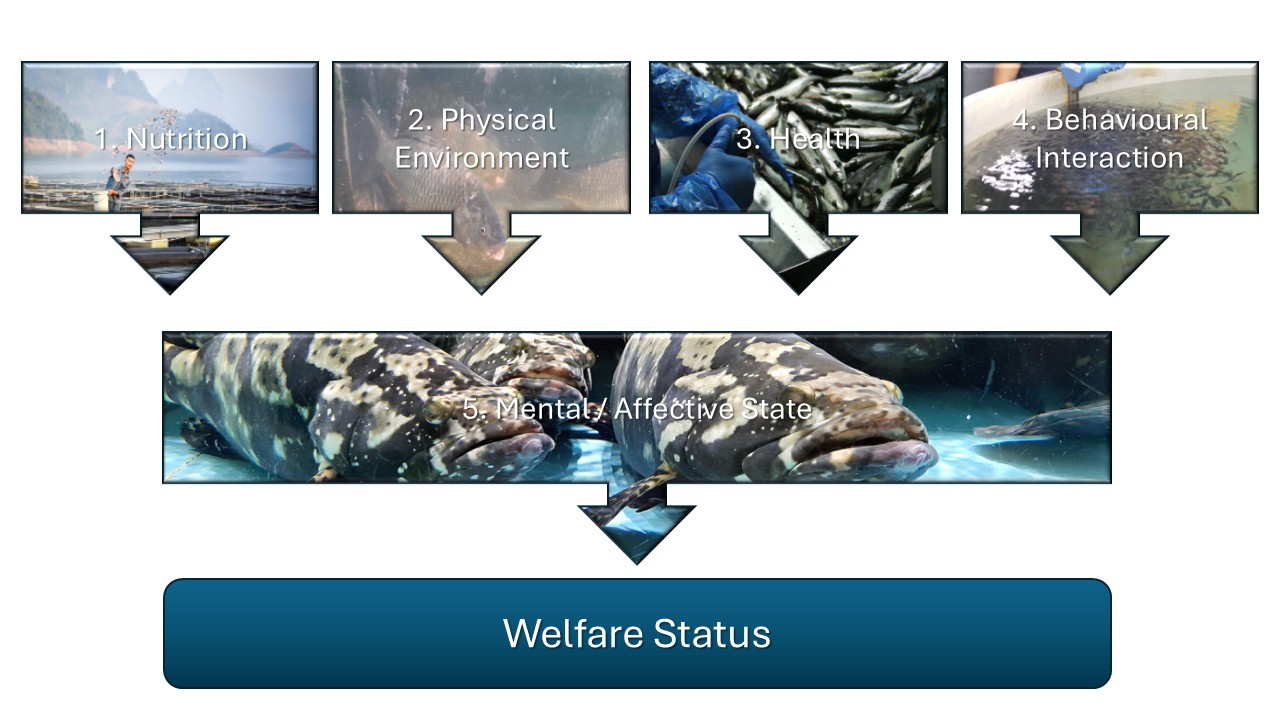 Figure 1.2: The five domain model of animal welfare (Image source: Authors) Diagram of the five domains showing boxes with arrows from the first four; Nutrition, Physical environment, Health and Behavioural interactions pointing towards the fifth box, Mental or Affective state. The arrow from that box then points towards the text "Welfare Status"
1) Nutrition: The animals should be provided with enough volume of water, and which should also have high food quality (e.g. planktons) in their ponds/tanks. However, clear water-based systems (e.g. RAS), the quality of plankton in water is not important. Make sure that the animals have enough quantities and high-quality food (e.g. natural and/or artificial). Artificial diet must be balanced, and different variety of feed/foods should be available according to the species requirement.
2) Environment: Water quality (e.g. temperature, dissolved oxygen, ammonia, nitrite, nitrate, pH, alkaline, hardness, ions) of the farmed animals should be prioritized, monitored, and maintained always at appropriate levels based on species specific requirements. Some group of animals need substrates to show positive experience and good welfare. The type, quality and quantity of substrates are also dependent on the farmed species. The area available in the ponds/tanks is essential to make sure that the farmed animals have enough space for freer movement and demonstrate their social behaviour. A combination of space and water quality, especial dissolved oxygen, will support to determine the carrying capacity of the ponds/tank which when exceeded can have negative impact on welfare outcomes. Other examples of environmental conditions include light quality and intensity used in closed systems farming systems, level of noise exposure (e.g. shrimp broodstock should be in areas with very minimal level of noise), and avoid high environment variability (e.g. maintain water quality under narrow variability window).
3) Health: Evaluate presence of diseases and injuries (e.g. acute, chronic), husbandry mutilation (e.g. eyestalk ablation), functional impairment (e.g. due to organ problems such as hepatopancreas in shrimp or gills in fish), contaminants/poisons in water, poor physical appearance and swimming activity. Adoption of practices to detect disease presence and to prevent or reduce disease incidence, injury, functional impairment, water poisoning and body condition are required.
4) Behaviour: The animals in ponds/tanks should be allowed to show all their natural behaviours which include free movement, exploration, foraging/hunting, bonding/reaffirming, bonds, rearing young, playing, sexual activity, using refugees, retreat or defensive attack, sleep/rest sufficient.
5) Mental state: This equates to the welfare status of the animals in the ponds/tanks which include all components from the first four domains.
For a more in-depth explanation of the five domains model please watch the following video:
NB: This third-party video is linked for illustration only and copyright and control belong entirely to the originating organisation