1.4 Welfare from another perspective - Allostasis and adaptation
An important consideration in animal welfare is determining the point at which unpleasant states are deemed to be significant enough to negatively impact an animal's welfare status. This section explores the distinction that must be attempted to be made between unpleasant stressors and suffering that definitively causes suffering and a compromise to animal welfare.
Pain, fear, hunger, boredom, and other states can obviously negatively impact welfare, but there is no realistic justification for deciding that such states always compromise an animal's welfare, particularly when they are an unavoidable part of normal animal life. A distinction must be attempted to be made between unpleasant versus suffering; i.e., at what point the frequency / severity of these unpleasant states significantly impacts animal welfare.
Suffering, in particular, could be identified when there is an acute / prolonged experience of unpleasant affective states because the animal is unable to respond in a way that would normally reduce risks in those circumstances.
The 'Allostasis' model, introduced in 2007, falls into this more dynamic view towards animal welfare (Figure 1.3 from Korte et. al. 2007). Rather than focusing on maintaining an animal's physiological, behavioural, and emotional states within some constant range that is typically accepted as a "stable equilibrium" (i.e., maintaining 'homeostasis'), it is the ability for the animal to change their coping strategies in anticipation to incoming (and currently existing) challenges / stressors that matters the most.
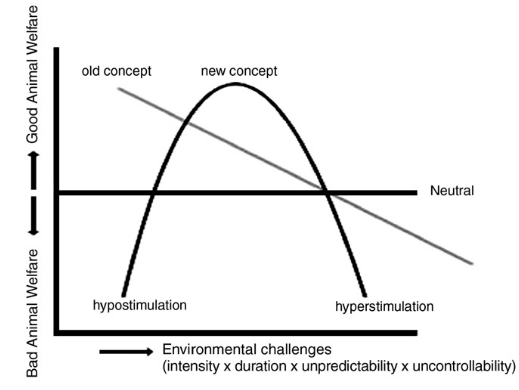 Figure 1.3. Comparing concepts of welfare in relation to increasing environmental challenges. The straight line represents the older concept of homeostasis, whereas the inverted U-curve is based on allostasis (Source: Korte, Olivier, and Koolhaas, 2007)
Therefore, the primary concern regarding 'suffering' should be avoiding situations where the challenges/pressures that are presented are too much (or even, too little / under-stimulating) for the animal to cope with.
Another helpful approach to tackling farmed animal welfare issues is to recognise that there are three classes of problems that can arise when the adaptations possessed by an animal do not fully correspond to the challenges posed by its current environment. This issue is commonplace when animals are reared in artificial, industrious conditions that often produce a degree of disconnect between the animal's natural behaviour, affective states, and basic health and functioning. This disconnect is often responsible for the disconnect that frequently arises between the three aforementioned concepts of welfare (natural, emotional, and functional states). Figure 1.4 below (modified from Fraser et. al. 1997) illustrates how these different approaches may be considered together:
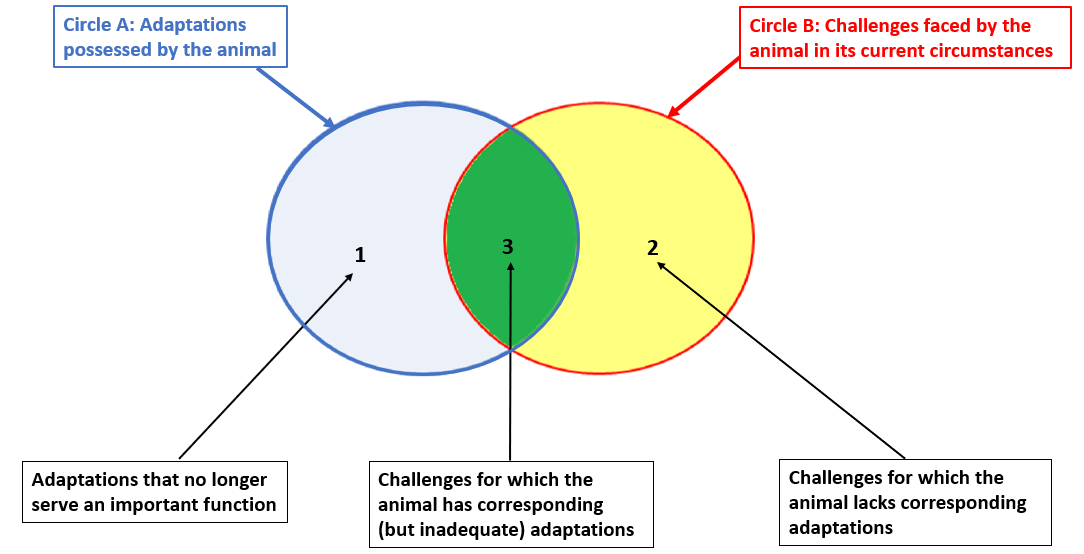 Figure 1.4: Illustrating the 3 broad classes of problems that can arise when the adaptations possessed by the animal (Circle A) do not completely fit/overlap with the challenges it faces under its current rearing conditions (Circle B). The diagram is modified from Fraser et. al., 1997. It shows two coloured and overlapping circles with the first labelled "1", the second "2" and the area of overlap "3". The first circle represents the adaptations posessed by the animal and the second circle the challenges faced by the animal in its current circumstances. The area of overlap represents the challenges for which the animal has corresponding (but inadequate) adaptations. The remaining area in the first circle represent adaptations that no longer serve and important function, whilst the remaining area in the second circle represent challenges for which the animal lacks corresponding adaptations.
The adaptations represented in Circle A can include anatomical, physiological, or behavioural features (even affective states such as hunger, fear, cold, pain etc. that motivate the animal to act in certain ways). Circle B represents challenges the animal faces in its current circumstances, and can include any stressors/pressure (exposure to cold, pathogens, predators, malnutrition. sensory deprivation etc.).
The blue area to the left of the overlap, "1", covers situations where the animal possesses adaptations that no longer serve a significant function in their current environment. Here, unpleasant subjective experiences (even to the point of "suffering") could arise even if not accompanied with significant disruption to the animal's physical health; for example, a pellet-fed fish experiencing a strong desire to forage for food even though it's well fed.
The yellow area to the left of the overlap, "2", encompasses challenges for which the animal has no appropriate adaptation to deal with. For example, certain species of fish fail to avoid certain contaminants (e.g., phenol) even at life-threatening levels. Serious biological functioning impairment can occur with such issues, and yet the animals may show no accompanying effects on their subjective experiences.
Finally, the central overlapping area, "3", involves examples where the animal faces challenges that they have corresponding but inadequate adaptations for. For example, ambient water temperatures may fluctuate beyond the animal's inadequate thermoregulatory adaptations. In this case, the animal's affective experience and functional state are negatively impacted.