
About this free course

Author

Download this course

Share this free course

Building motivation and resilience in research

Start this free course now. Just create an account and sign in. Enrol and complete the course for a free statement of participation or digital badge if available.

1.1 What is resilience?

Resilience is more than just surviving challenges – it’s about adapting, learning, and coming back stronger. In research or project work, resilience helps you:

  • maintain motivation when progress is slow
  • learn from failures and adjust strategies
  • handle criticism constructively
  • persevere towards long-term goals.

Here are some examples from history:

  • Marie Curie faced multiple rejections before winning Nobel Prizes. Resilience is not about avoiding setbacks but using them as fuel for persistence.
  • Albert Einstein described failure as ‘success in progress’, a phrase that encapsulates the idea that failure is not the opposite of success but rather a stepping stone toward it.
Interactive feature not available in single page view (see it in standard view).

Psychological theories also support this perspective. Bandura’s (1997) self-efficacy theory argues that belief in one’s own ability to succeed influences persistence. Researchers with high self-efficacy interpret setbacks as challenges to be mastered, while those with low self-efficacy may see the same setbacks as evidence of inadequacy. Resilience, therefore, is closely tied to how we interpret and respond to difficulties.

Activity 1: Reflecting on research challenges

Timing: 10 minutes

Take a look at the options in the Challenges Bingo card and consider which ones you have experienced. Fill in your own experiences in the table below.
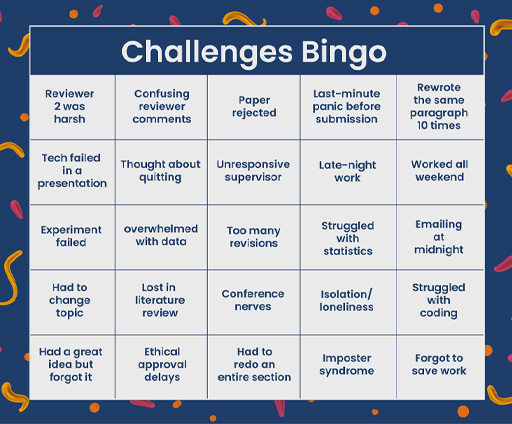
PHD Challenges Bingo card
Table 1: Challenges Bingo card: your own experiences
To use this interactive functionality a free OU account is required. Sign in or register.
Words: 0
Interactive feature not available in single page view (see it in standard view).

Now think about a recent challenge in your research or project work. Write down:

  • What happened?
  • How did you respond?
  • What could you do differently next time to grow from this experience?
To use this interactive functionality a free OU account is required. Sign in or register.
Interactive feature not available in single page view (see it in standard view).