

1.3 Developing resilience
The encouraging reality is that resilience can be nurtured. According to Angela Duckworth’s (2016) concept of grit, long-term success depends not just on talent but on passion and sustained perseverance. Developing resilience means equipping yourself with tools and habits that make perseverance easier when obstacles appear.
Some key strategies include:
- adaptability – the capacity to adjust methods or goals when circumstances change
- optimism – cultivating a hopeful outlook that frames challenges as temporary and solvable
- support networks – seeking advice, feedback, and encouragement from peers, mentors, or supervisors
- reflection – regularly reviewing what has worked, what has not, and what can be improved.
Activity 2: Self-assessment on handling research challenges
Below are statements about how you approach challenges in research. For each one, rate yourself on a scale of 1–5.
- rarely true
- sometimes true
- neutral / occasionally true
- often true
- always true
1. I see research setbacks as part of the learning process.
2. I believe effort and persistence are more important than talent.
3. I stay motivated even when progress is slow.
4. I view criticism as a way to improve rather than a personal attack.
5. I accept that uncertainty is a normal part of research.
6. I actively seek help from supervisors, peers, or mentors.
7. I adjust my approach when faced with unexpected obstacles.
8. I take breaks and set boundaries to avoid burnout.
9. I celebrate small achievements to stay motivated.
10. I reflect on past challenges and how I overcame them.
11. When faced with a rejected paper, I see it as an opportunity to improve.
12. I adapt my plans when experiments don’t go as expected.
13. I maintain a healthy work-life balance during stressful periods.
14. I remind myself that setbacks are normal in research.
15. Tally your total score (out of 70).
- If you scored between 56–70 (Mostly 4s & 5s): You already use strong resilience strategies. Keep reinforcing them.
- If you scored between 35–55 (Mixed scores): You’re developing resilience but may benefit from strengthening certain areas.
- If you scored between 14–34 (Mostly 1s & 2s): Consider experimenting with new coping techniques and strategies to broaden your toolkit.
Take some reflection and/or action notes in the box below, based on your score.
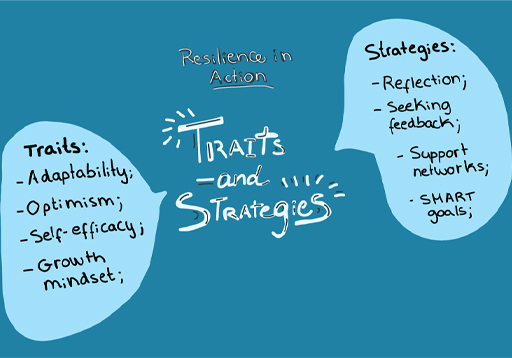
So, to wrap up this section: resilience isn’t something only a few ‘extraordinary’ scientists have. It’s actually a set of skills and attitudes that anyone can build with practice, reflection, and the right support. Keeping this in mind will set you up perfectly for the next part of the course, where we’ll dive into the most common research setbacks and how to handle them in a constructive way.
For a more comprehensive assessment, you might find the Resiliency Quiz by Al Siebert [Tip: hold Ctrl and click a link to open it in a new tab. (Hide tip)] insightful.