The European approach to One Health
One Health is a global topic. The EU puts a lot of energy into realising its (sustainability) goals. Therefore, the EU approaches many “new” aspects/regulations from a One Health perspective or takes it into account. The following should help to understand the goal of One Health and what aspects have to be considered to fulfill its requirements.
The One Health approach aims to equally prioritize environmental, animal, and human health as interdependent systems. The EU applies a transdisciplinary approach involving collaboration across sectors (public health, veterinary, environmental sciences, policy, etc.)
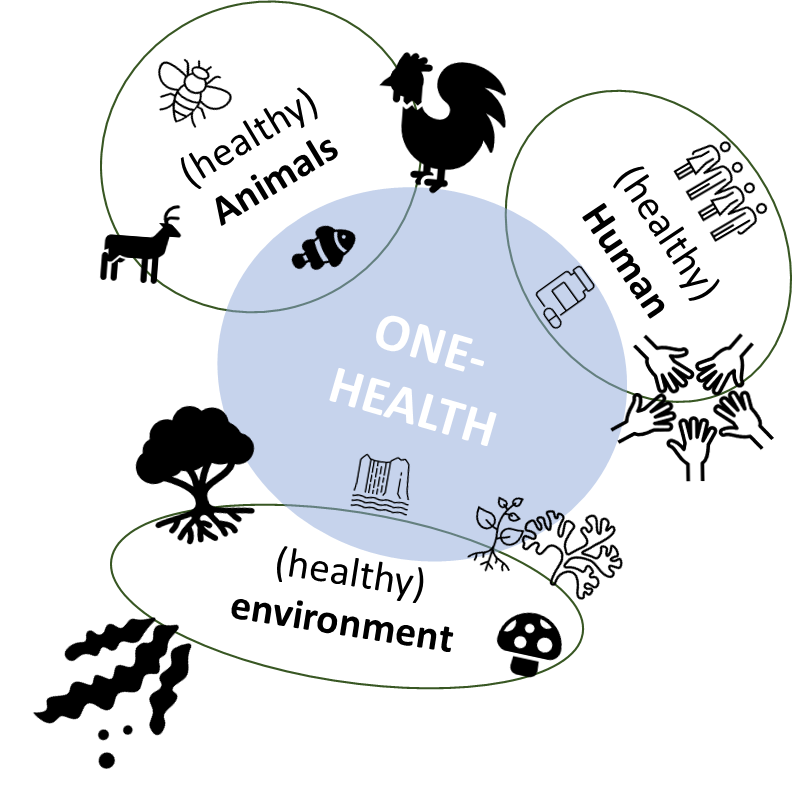 A diagram consisting of a circle, named one health, which is overlapped by oval shapes that are titled healthy animals, healthy humans and healthy environment, to show their interrelation.
One Health as an approach and a way of thinking aims to equally optimize outcomes for animal, human and environmental health.
Due to the interdependence of everything (i.e. everything is connected), the impact of (human) actions has far-reaching and often underestimated effects.
Ecosystems are affected by human activity. They in turn affect us.
This includes physical-, biological-, chemical- and lifestyle related risks.
These risks originate from different sources: food safety, clean water, hygiene, climate, living conditions; standards of living, etc. …
Different aspects to look at, from a One Health perspective are the blue economy, especially fisheries and aquaculture and their impact on the environment and natural biodiversity (climate change).
The goal of the European approach is to contribute to a better human (“public”), animal and environmental health, including food safety.
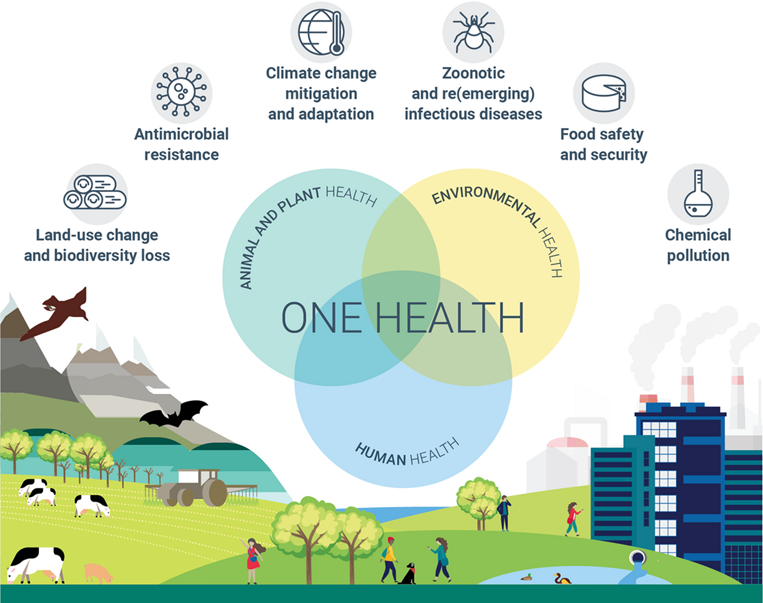
A figure with a stylized landscape and cityscape on the bottom, a venn diagramm of One Health consisting of Animal and Plant health, Environmental health and Human health in the center and six aspects in an arc above it. They read: Land-use change and biodiversity loss, Antimicrobial resistance, climate change mitigation and adaptation, zoonitic and re(emerging) infectious diseases, food safety and security, and chemical pollution. (Source: European Environment Agency)
The EU strategy aims to:
- Build a strong European Health Union
- Promote sustainable and safe food
- Protect health and welfare of farmed animals
- Protect health of crops and forests
→ Monitoring the implementation of related laws is crucial
→ Fostering education and advanced training courses is a key feature
The Public Health department is responsible for EU policy on food safety and health and for monitoring the implementation of related laws.