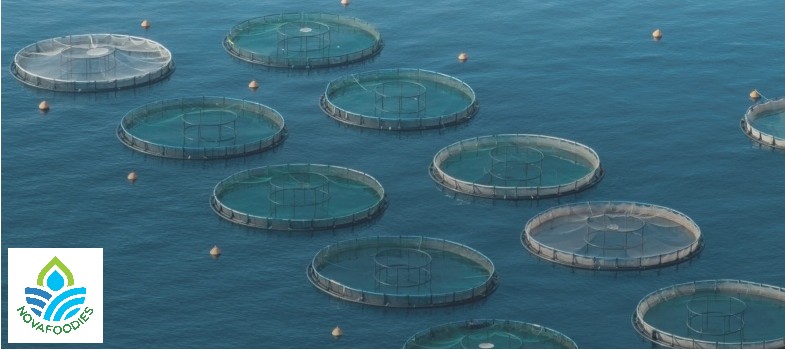
Typical IMTA Set-up
A typical IMTA set-up might include fed fish farmed in pens, tanks or cages, these fish release waste into the surrounding water. Filter feeders, such as mussels or other bivalves, can be grown adjacent to the pens to use this waste to grow, by filtering out the small particulate organic matter (POM). Seaweed could also be included and these absorb the dissolved inorganic nutrients, or minerals, from the water to grow.
Finally, an invertebrate —such as sea-cucumber, sea urchins or worm—, could be grown on the sea-bed, which would feed on the larger organic waste that falls to the sea-bed, from both the fed fish species and from the filter feeders. Microorganisms present in the water likely play a role as well, but their influence has not yet been thoroughly studied. Therefore, the lower-trophic species are used as extractive species in IMTA.
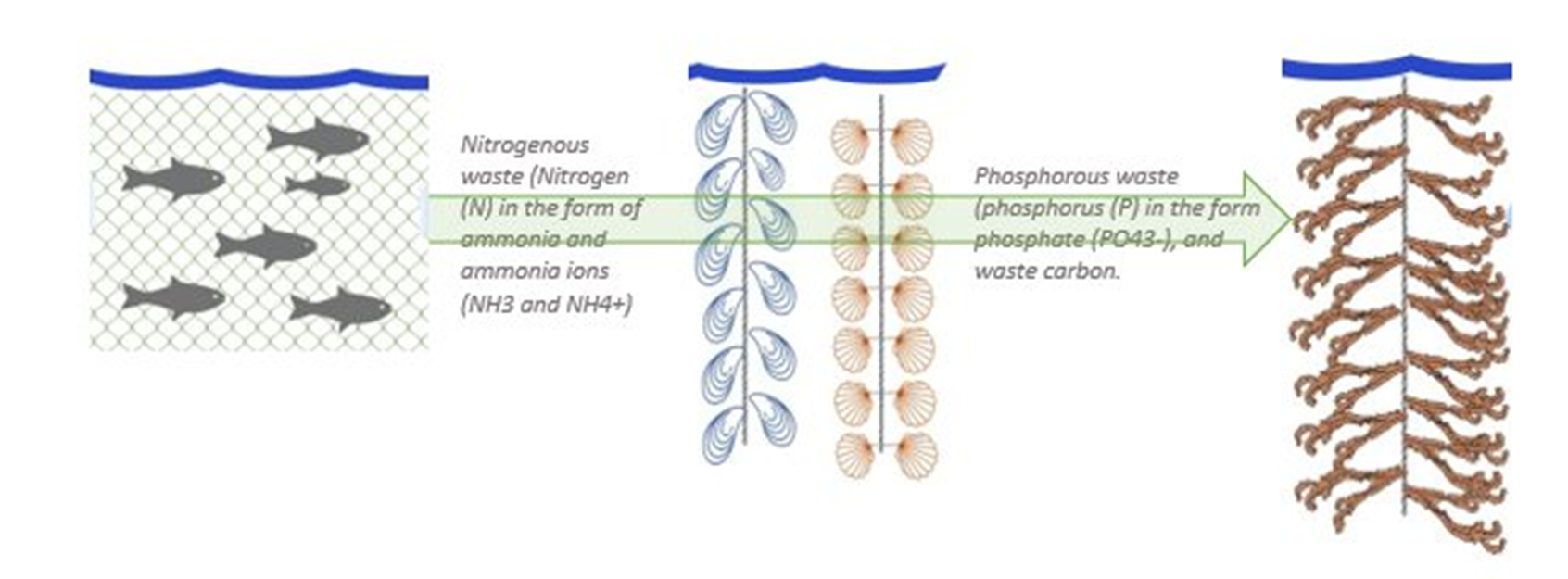 A diagram of an underwater IMTA set-up. There are three images from left to right, connected by an arrow and by text. The left image is of fish in a net or cage. The middle image is of molluscs hanging from a rope. The text in between reads: Nitrogenous waste (Nitrogen N) in the form of ammonia and ammonia ions (NH3 and NH4+). The image on the right shows a rope with macroalgae growing on it. The text between the middle and right image reads: Phosphorous waste (phosphorus P) in the form of phosphate (PO43-), and waste carbon.
The most appropriate combination of species depends on a number of factors, such as the site, the environment, the inputs, the water and currents, as well as the economic factors, the social factors, the experience of the farmer, and the regulatory factors. The combination of these factors will lead to different choices in the design of the best suited IMTA system for any specific location.
Ideally, the co-cultured species should be more than just bio-filters - they should also be harvestable crops of economic value. Having a second product is useful as it gives product diversity and creates a second revenue stream, but the value of IMTA is much more than commercial. The ecosystem services provided can be a huge benefit from the system. IMTA reduces the environmental impact; it uses the space more efficiently. This gives a boost to consumer perception of the products, and in the societal and the political license to operate. These are key benefits to the aquaculture sector in general.