Challenges of IMTA
The adoption of integrated multi-trophic aquaculture (IMTA) and other diversified farming systems faces a range of interconnected challenges that span regulatory, economic, operational, and skill-based dimensions. Current licensing frameworks, designed with monoculture in mind, are often ill-suited to the complexities of multi-species cultivation, creating bureaucratic hurdles and unpredictable approval processes. Economically, the lower market value of species like shellfish and seaweed, combined with the high upfront costs of infrastructure and equipment, can deter investment and limit profitability. Operationally, the increased complexity of managing multiple trophic levels introduces risks such as disease transmission, resource competition, and nutrient imbalances, requiring careful oversight and adaptive management. Finally, the lack of familiarity with these systems and the scarcity of successful, large-scale models further hinder widespread adoption, as producers may be reluctant to move away from established practices without clear guidance or proven examples. Together, these factors create a significant barrier to the expansion of more sustainable and diversified aquaculture practices.
Regulation
Licensing systems for aquaculture are primarily designed to support monoculture practices, which can create significant barriers for more diverse farming approaches. These systems vary widely between countries and are often complex, time-consuming, and lack transparency regarding processing times and expected outcomes. As a result, obtaining licenses for multi-species cultivation — such as integrated multi-trophic aquaculture (IMTA) — can be particularly challenging, as existing frameworks may not adequately address the unique requirements of these systems.
Market Value
The market for farmed aquatic species is marked by uncertainty, especially when comparing different trophic levels. Species such as shellfish, invertebrates, and seaweed generally command lower market values than cultured fish, which can impact the economic viability of diversified aquaculture operations. Additionally, the high costs associated with converting existing fish farms or building new facilities, along with the need for specialized equipment and infrastructure, pose further financial challenges for producers.
Complexity
Managing multi-species aquaculture systems introduces a higher level of complexity compared to monoculture. Incorporating more trophic levels increases operational costs and requires greater effort in monitoring and maintenance. Unknown factors, such as species interactions, disease transmission, competition for resources, and imbalanced nutrient uptake, can lead to unforeseen problems and complicate the overall management of these integrated systems.
Familiarity and Skills
The transition to multi-species aquaculture demands the acquisition of new skills and knowledge, which can be a significant hurdle for producers accustomed to traditional monoculture practices. The familiarity and perceived reliability of current systems often make change seem risky. Furthermore, the limited number of large-scale, successful IMTA farms means there are few demonstration models available, making it harder for new entrants to adopt and adapt to these innovative approaches.
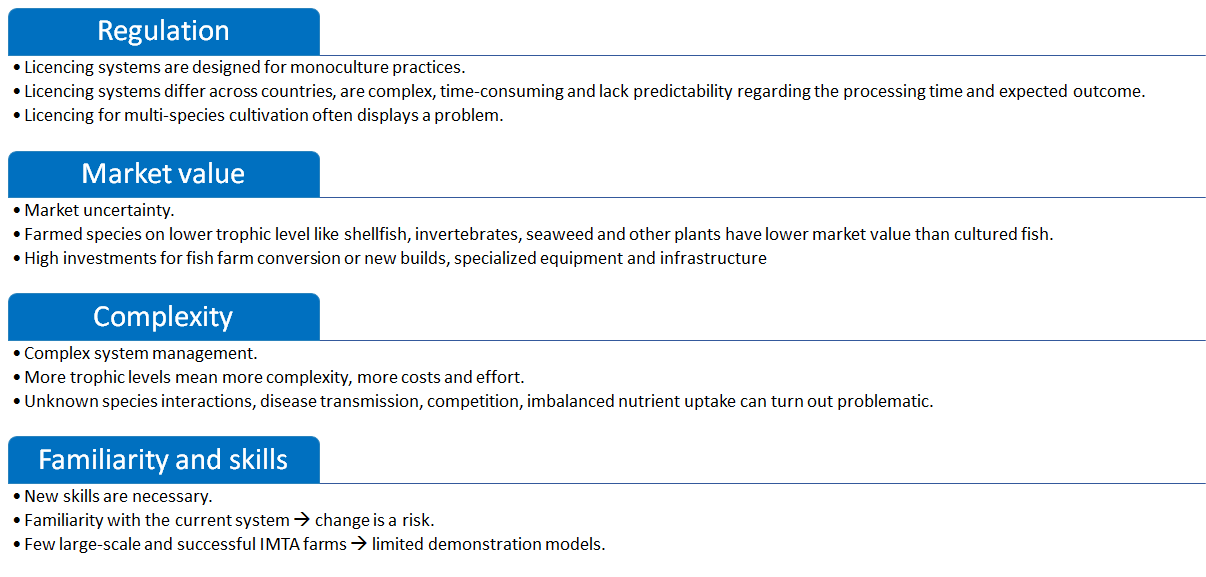 Regulation Licencing systems are designed for monoculture practices. Licencing systems differ across countries, are complex, time-consuming and lack predictability regarding the processing time and expected outcome. Licencing for multi-species cultivation often displays a problem. Market value Market uncertainty. Farmed species on lower trophic level like shellfish, invertebrates, seaweed and other plants have lower market value than cultured fish. High investments for fish farm conversion or new builds, specialized equipment and infrastructure. Complexity Complex system management. More trophic levels mean more complexity, more costs and effort. Unknown species interactions, disease transmission, competition, imbalanced nutrient uptake can turn out problematic. Familiarity and skills New skills are necessary. Familiarity with the current system → change is a risk. Few large-scale and successful IMTA farms → limited demonstration models.