1. Goal and Scope
The first step of a Life Cycle Assessment study is to clearly define its purpose and intended application, ensuring that the assessment is aligned with specific goals and provides relevant insights. The scope of the study involves determining the system boundaries, which outline the processes and stages included in the LCA, such as cradle-to-grave or cradle-to-gate analyses. Additionally, the scope includes establishing the functional unit, which quantifies the performance of a product system and serves as a reference point for the assessment. It is also crucial to document any assumptions made during the study and to identify potential limitations, ensuring transparency and providing a clear understanding of the study's constraints and boundaries.
System Boundaries
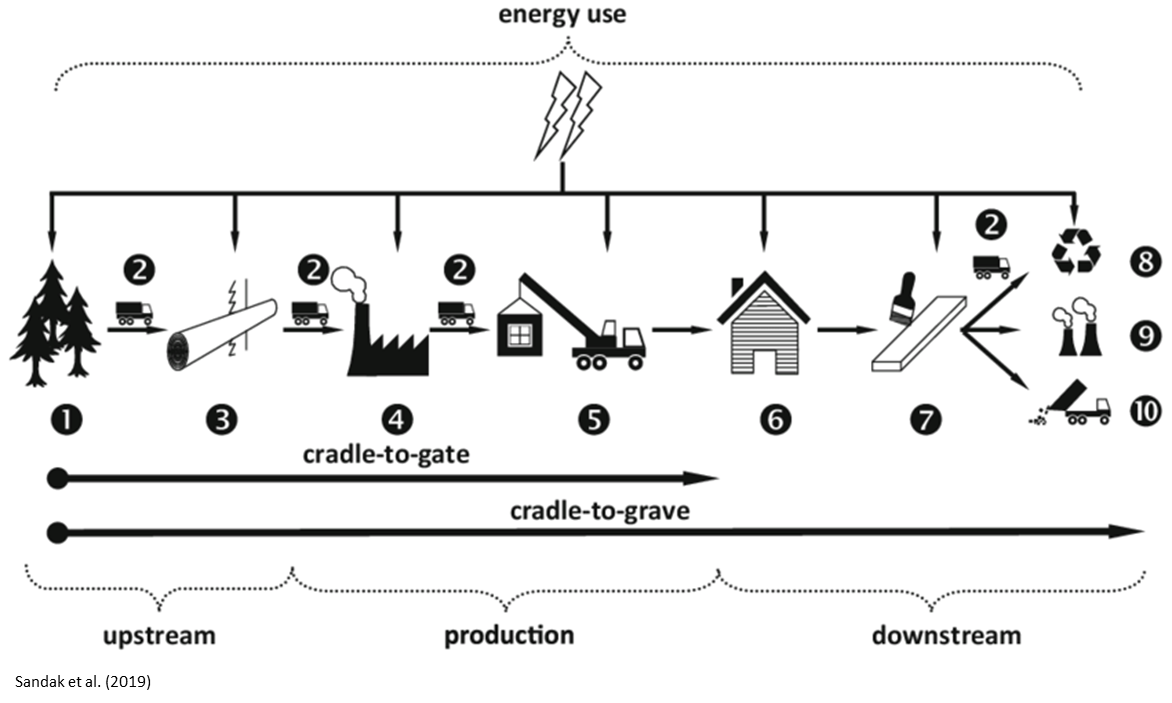 Cradle-to-gate and cradle-to-grave concepts as the LCA system boundaries: 1) harvest of raw material, 2) transport, 3) primary processing, 4) secondary processing, 5) construction/ assembling, 6) use phase, 7) maintenance, 8) recycling/reuse, 9) energy generation, 10) landfilling
Cradle-to-Grave: This type of LCA assesses the environmental impacts of a product from raw material extraction (cradle) to disposal (grave). It covers the entire life cycle, including production, use, and end-of-life stages.
Cradle-to-Gate: This LCA focuses on the environmental impacts from raw material extraction to the point where the product leaves the manufacturing facility (gate). It does not include the use and disposal phases.
Gate-to-Gate: This type of LCA examines the environmental impacts of a specific process or stage within the production chain. It is often used to assess the efficiency of individual manufacturing processes.
Cradle-to-Cradle: This approach evaluates the entire life cycle of a product, but with a focus on creating a closed-loop system where the end-of-life product is recycled back into the production process, minimizing waste.
Well-to-Wheel: Commonly used in the automotive and energy sectors, this LCA assesses the environmental impacts of fuel production and use, from extraction (well) to vehicle operation (wheel). It includes stages such as fuel extraction, processing, distribution, and combustion.