Further Information on LCA
Reporting and Critical Review
Reporting and Critical Review involve documenting the entire Life Cycle Assessment process and subjecting it to a critical review to ensure accuracy, transparency, and credibility. This phase includes compiling all the data, methods, results, and interpretations into a comprehensive report. The critical review, often conducted by independent experts, evaluates the study for consistency, completeness, and adherence to standards, providing an additional layer of validation and enhancing the reliability of the LCA findings. Here, it is also useful to acknowledge the limitations of the LCA study and to specify conditions for its use.

There is a plethora of approaches to LCA. Each method may differ in their approaches and objectives.
Process-based LCA is the traditional method of life cycle assessment, involving detailed data collection for each process within the system boundaries. This bottom-up approach measures emissions, resource use, and other environmental impacts directly from each activity involved in the product's life cycle. It provides high-resolution data and is particularly useful for identifying specific areas for environmental improvement within a product system.
Input-Output LCA uses economic input-output tables to estimate environmental impacts based on economic transactions between sectors. This top-down approach captures the broader economic interactions and indirect environmental effects that occur throughout the supply chain. It is particularly useful for assessing the environmental impacts of large-scale economic activities and for identifying hotspots in complex supply chains.
Hybrid LCA combines the strengths of both process-based LCA and input-output LCA, integrating detailed process data with economic input-output data. This approach provides a more comprehensive assessment by capturing both direct and indirect environmental impacts. Hybrid LCA is particularly valuable for complex systems where both high-resolution process data and broader economic interactions need to be considered.
Consequential LCA focuses on the broader consequences of changes in a product system, including market effects and indirect impacts. Unlike traditional LCA, which assesses the impacts of a product as it exists, consequential LCA evaluates the environmental implications of decisions, policies, and changes in demand. This approach is useful for understanding the potential long-term and systemic effects of introducing new products or technologies.
Dynamic LCA incorporates temporal changes in environmental impacts over time, accounting for variations in technology, resource availability, and environmental conditions. This approach provides a more accurate assessment of long-term impacts by considering how these factors evolve. Dynamic LCA is particularly useful for assessing the sustainability of products and systems in the context of future scenarios and changing environmental conditions.
Critique of LCA
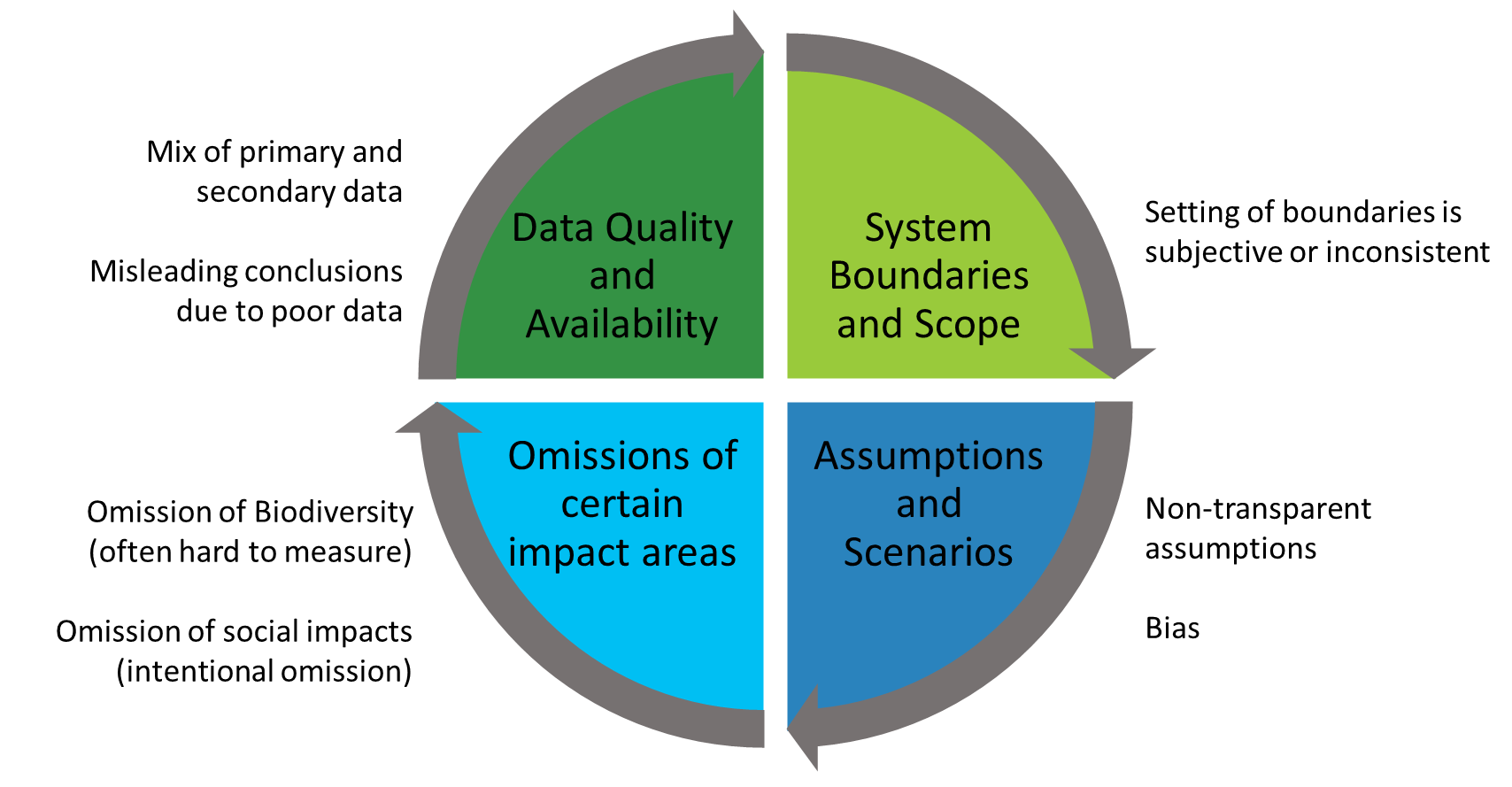 A circular diagram which symbolize a loop containing four sections that are titled: Data Quality and Availability, System Boundaries and Scope, Assumptions and Scenarios, and Omission of certain impact areas. Starting with Data Quality and Availability, the following examples are assigned to the quarters: Mix of primary and secondary data and Misleading conclusions due to poor data; Setting of boundaries is subjective or inconsistent; Omission of Biodiversity (often hard to measure), Omission of social impacts (intentional omission); Non-transparent assumptions, Bias
LCA studies face several significant challenges that can affect their accuracy and reliability. One primary issue is the quality and availability of data. As LCAs often rely on a mix of primary and secondary data, incomplete or outdated information can lead to misleading conclusions. Defining the system boundaries and scope of an LCA can be subjective and inconsistent, with different studies including or excluding various stages of the life cycle, leading to variations in results and making comparisons difficult. Additionally, LCAs involve numerous assumptions and scenarios to model real-world processes, which can introduce uncertainty and variability into the results, as they may not accurately reflect actual conditions. Furthermore, some LCAs may omit certain environmental impact areas, such as biodiversity loss or social impacts, due to the complexity of modeling these effects, resulting in an incomplete assessment of a product's overall sustainability. These challenges highlight the complexities and potential limitations inherent in conducting comprehensive and accurate LCA studies.
In summary, LCA is...
- a tool to describe the systems and understand the environmental hot spots of the aquaculture systems, i.e. it can help improving these systems.
- a means to go towards an ecodesign of the production systems.
- highly vulnerable to the quality of the used data.
- dependent on a clear analysis of the impacts so as to avoid mistakes and misinterpretations (even concerning the one undertaking the endeavor).
- a tool that is constantly undergoing change and improvement through the addition of new legislation that increases LCA’s completeness and usefulness.
It is not meant to serve greenwashing campaigns or false advertising!