
Life Cycle Assessment (LCA)
Life Cycle Assessment (LCA) was developed to evaluate the environmental impacts associated with a product's life cycle, providing a comprehensive approach to understanding the ecological footprint of various products and processes. The concept of LCA gained significant traction following a pioneering environmental impact study conducted by Coca-Cola in 1969, which played a foundational role in shaping the LCA methodologies used today. This approach allows for a detailed analysis of the environmental effects of a product from its inception to its disposal.
A typical LCA study can encompass the entire value chain, including raw materials, manufacturing processes, and end-of-life disposal, while also considering the inputs and outputs of the processes involved, such as energy and water usage. Generally, an LCA study follows a structured framework that is outlined by the ISO 14040 standard. This systematic approach ensures that all relevant environmental impacts are thoroughly evaluated, providing valuable insights for improving sustainability and reducing ecological harm.
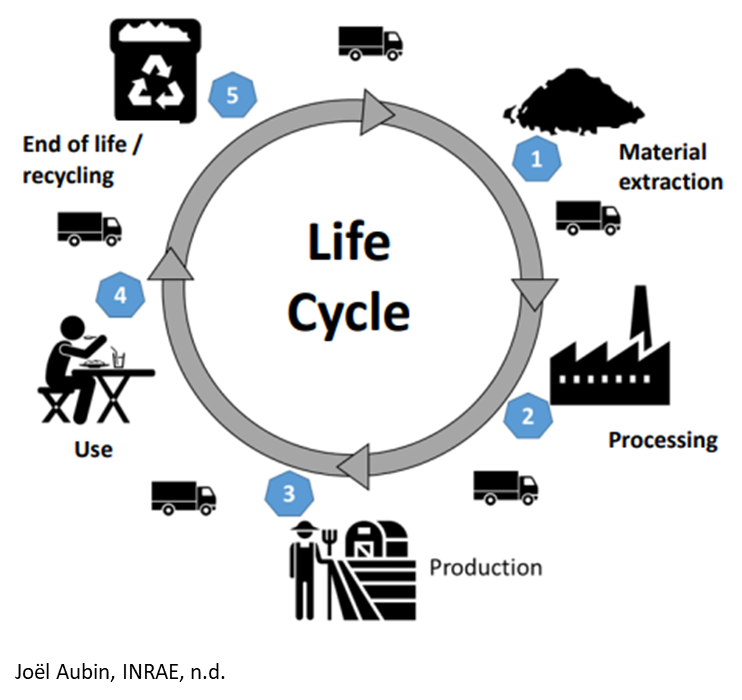 The life cycle of a product starting from Material extraction and moving onto processing, production, use, and end of life/recycling.
Since its first standardization in 1997, Life Cycle Assessment (LCA) has undergone significant updates, with major revisions occurring in 2006. These updates have been crucial in refining the methodologies and ensuring that LCA studies remain relevant and accurate in assessing environmental impacts. The standardization process has helped establish a robust framework that guides practitioners in conducting comprehensive and reliable LCAs.
ISO 14040 is a foundational standard that outlines the principles and framework for conducting LCA. It provides a structured approach to ensure consistency and reliability in LCA studies. The standard encompasses several key phases, including setting the goal and scope, conducting a Life Cycle Inventory (LCI), performing a Life Cycle Impact Assessment (LCIA), and interpreting the results. Each of these phases is essential for a thorough and accurate assessment of a product's environmental impacts throughout its life cycle.
Complementing ISO 14040, the ISO 14044 standard provides detailed requirements and guidelines for each phase of an LCA. This standard ensures that practitioners have clear and specific instructions for conducting each part of the assessment, from defining the scope to interpreting the results. Together, ISO 14040 and ISO 14044 form a comprehensive framework that enhances the credibility and effectiveness of LCA studies, making them invaluable tools for environmental management and sustainable development.
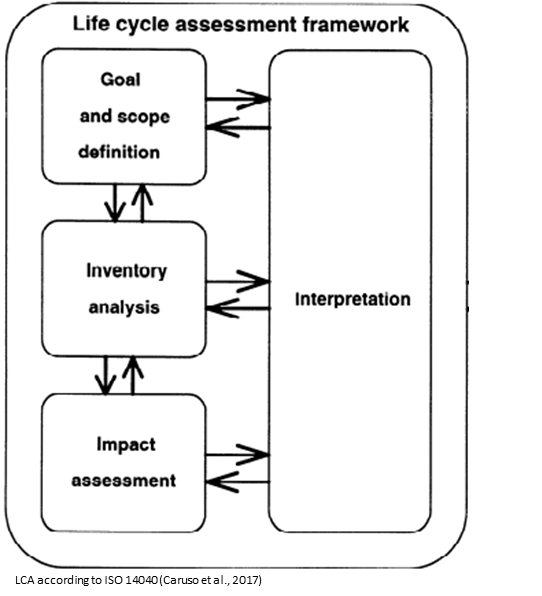
The figure shows the LCA structure according to ISO 14040. It includes Setting Goal and Scope, Life Cycle Inventory (LCI), Life Cycle Impact Assessment (LCIA), and Life Cycle Interpretation.
In what is to follow, we shall investigate each LCA phase in more detail.