Key benefits of IMTA
In the linear model, the food is fed to the fish and the fish waste is released for dilution in the environment. IMTA makes use of this product to serve as a food source for other farmed species, thus reducing waste and reusing the nutrients in another commercial product — such as shellfish and or seaweed.
IMTA replaces the dilution of waste principle with extraction and the conversion of these excess nutrients and energy into other commercial crops. The farm copies the natural cycles in the ecosystem and allows the reuse of nutrients, reducing waste and environmental impacts. IMTA provides a waste reduction service to the industry. This bioremediation element can contribute to meeting regulations and discharge limits, e.g. cleaning the water on site so it can be discharged pristine, or to be reused.
To increase circularity, the seaweed, plants or other species grown could be used as an ingredient in the fish food, creating a full circular system. This form of IMTA reduces the ecological impacts near the aquaculture operation while providing additional useful products. This reduction in ecological impacts and circularity is desirable from both a regulator and a consumer point of view, so IMTA can have the advantage of improving the societal perception of aquaculture.
Ideally, the co-cultured species should be more than just bio-filters - they should also be harvestable crops of economic value. Having a second product is useful as it gives product diversity and creates a second revenue stream, but the value of IMTA is much more than commercial. The ecosystem services provided can be a huge benefit from the system. IMTA reduces the environmental impact; it uses the space more efficiently. This gives a boost to consumer perception of the products, and in the societal and the political license to operate. These are key benefits to the aquaculture sector in general.
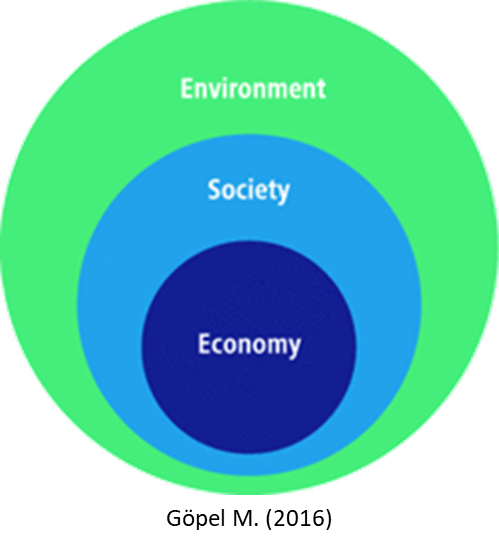
The nested, or embedded system shows three circles, the innermost is titled economy, the next circle is titled society and the large circle, that encompasses the other two, is named environment. The “nested dependencies” sustainability model demonstrates that the environmental, social and financial components are inter-dependent of one another but not reducible to the other (emergence). The nested model recognizes that economic activities are embedded within social systems, which in turn are embedded within ecological systems, while e.g. the common pillar approach leads to a fragmented view, often resulting in the prioritization of one pillar (economy) at the cost of the other two.
Environmental benefits:
Reduction of environmental impact through:
- Copy of natural cycle in the ecosystem
- Ensures water can be discharged either pristine or reused
- Minimising environmental impact and interference with natural ecosystems near aquaculture operations
- High potential for nutrient load reduction and nutrient recycling (improves water quality and reduces waste)
- Ocean-based proteins are substantially less carbon-intensive than land-based proteins (actions that lead to a diet shift to lower carbon protein help reduce emissions)
- Supports polyculture systems by providing a variety of species (avoids monoculture)
- Enhances biodiversity (shelter and habitat for various marine species)
Economic benefits to farmers:
- Alternative incomes, cashflows and revenue streams
- Providing diverse product offerings
- Reduces the need for costly water treatment, especially in land-based IMTA systems
- Enables premium pricing for niche product (the product is more circular and environmentally sustainable than most others)
- Encourages cooperation among farmers (e.g. everyone responsible for other species)
- Enhances business resilience in many aspects (e.g. environmental, due to global warming, economic, due to consumer demand, …)
- Optimises space use (various products are produces within the same space)
Social benefits:
- Compared to fish farmers, workers in aquaculture benefit from:
- certainty of working location (household stability)
- access to education, health provision, and appropriate housing
- regularity of working hours
- more predictable returns (in both time and value) - easier to make informed financial planning decisions and investments
- Compared to conventional aquaculture systems:
- Benefits above are at risk – IMTA is more resilient (disease outbreak, food safety recalls, natural disasters
- In conventional aquaculture systems those benefits are at risk, as compared to IMTA, they collapse more easily e.g. due to disease outbreaks, food safety recalls, natural disasters
- In addition, conventional aquaculture leads to aesthetic impacts (perceived environmental damage) e.g. cluttered views of the seascape