Sustainability and Environmental Impacts
Perspectives on sustainability
The concept of sustainability has accrued a wide variety of understandings and perspectives over the years. Two such perspectives are "embeddedness" and "pillars".
The concept of embeddedness of systems highlights the interdependence between various components that support our ability to produce and sustain goods. This production capability is underpinned by the presence of a thriving ecosystem and a structured society, which further encompasses institutions like markets. It is crucial to note that the collapse of the environmental dimension leads to the failure of both society and the economy, rather than the converse. This illustrates the foundational role that environmental stability plays in supporting societal and economic structures.
In contrast, the pillars of sustainability metaphor suggests that removing any single pillar—whether environmental, social, or economic—does not necessarily result in the immediate collapse of the entire system. This perspective introduces the debate between weak and strong sustainability. Weak sustainability posits that different forms of capital (natural, human, and manufactured) can substitute for one another, whereas strong sustainability argues that natural capital is irreplaceable and must be preserved to maintain the overall system's integrity. This distinction underscores the varying approaches to understanding and achieving sustainable development.
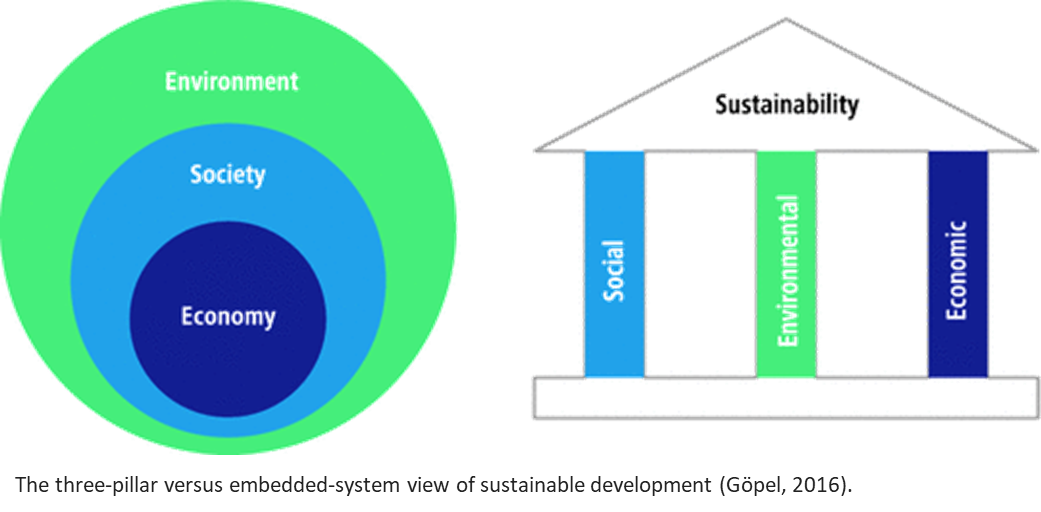 The nested, or embedded system shows three circles, the innermost is titled economy, the next circle is titled society and the large circle, that encompasses the other two, is named environment. The pillar view shows a base, three pillars named Social, Environmental and Economic. The pillars hold a roof (triangle shaped) that reads sustainability.
Possible influences and impacts on the environment
Influences and impacts can be multifaceted and intricately interconnected, often presenting as wicked problems that defy simple solutions. These influences can be either overt or hidden, posing challenges for detection through natural science research and social institutions alike. The complexity of these issues requires a nuanced understanding and a multidisciplinary approach to unravel the various layers and interactions at play.
The relationship between environmental influences and sustainability is frequently a subject of deliberation and debate. Different actors may have varying perspectives on the severity of an impact, such as greenhouse gas (GHG) emissions, and the urgency for change. While some stakeholders may advocate for immediate action, others might not perceive the issue as relevant or pressing. This divergence in viewpoints underscores the need for comprehensive dialogue and collaborative efforts to address sustainability challenges effectively.
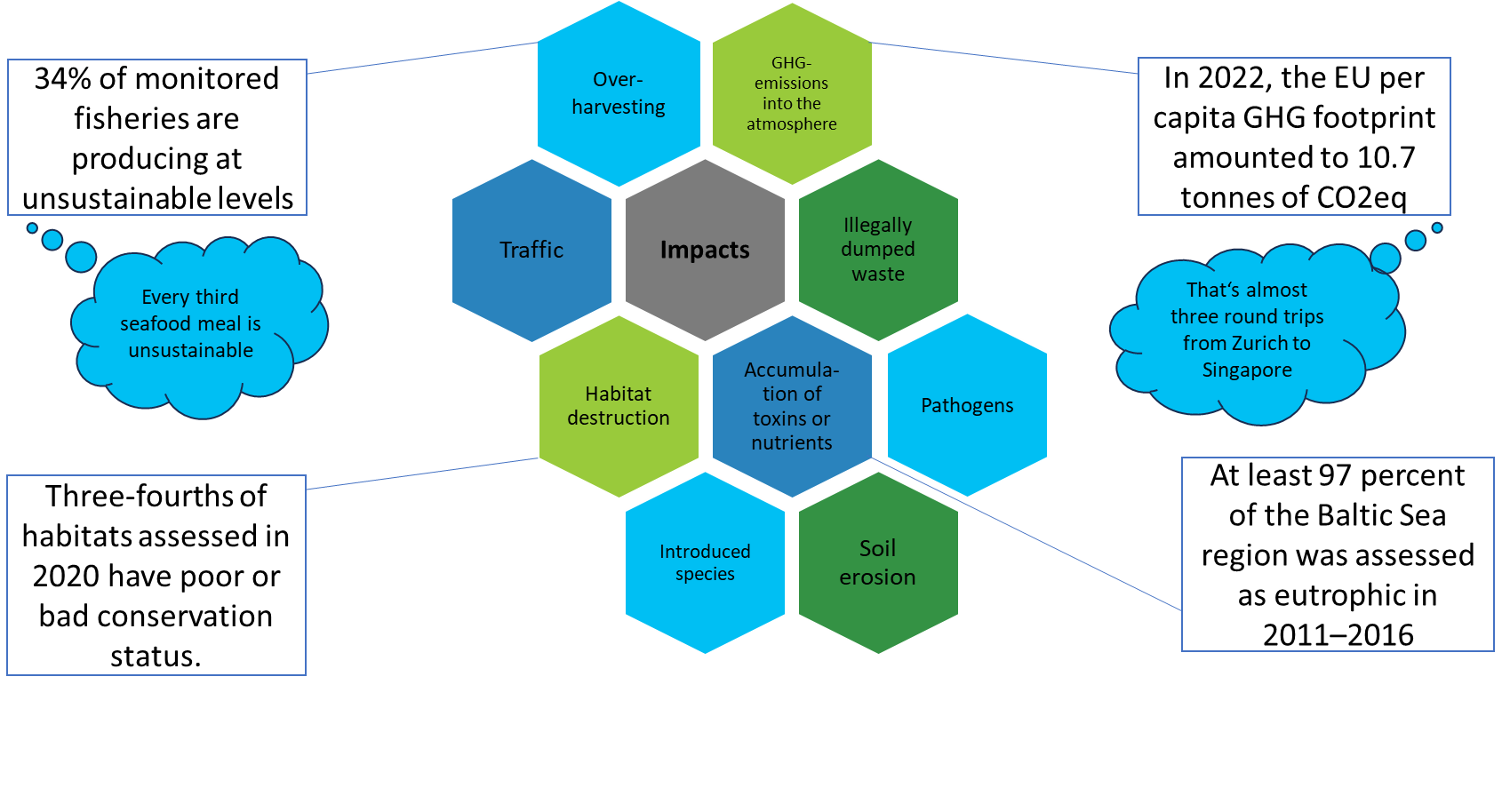 An assembly of possible impacts: overharvesting, traffic, soil erosion, GHG-emissions into the atmosphere, illegally dumped waste, habitat destruction, accumulation of toxins or nutrients, pathogens, introduced species.