Integrated aquaculture is relatively new in Europe and the western world (as opposed to Asia, where it has a long history), which tended to focus on mono-culture in farming practises and have followed a similar path with the development of aquaculture. When we talk about IMTA we have 3 elements: the integrated, the multi-trophic, and the Aquaculture elements:
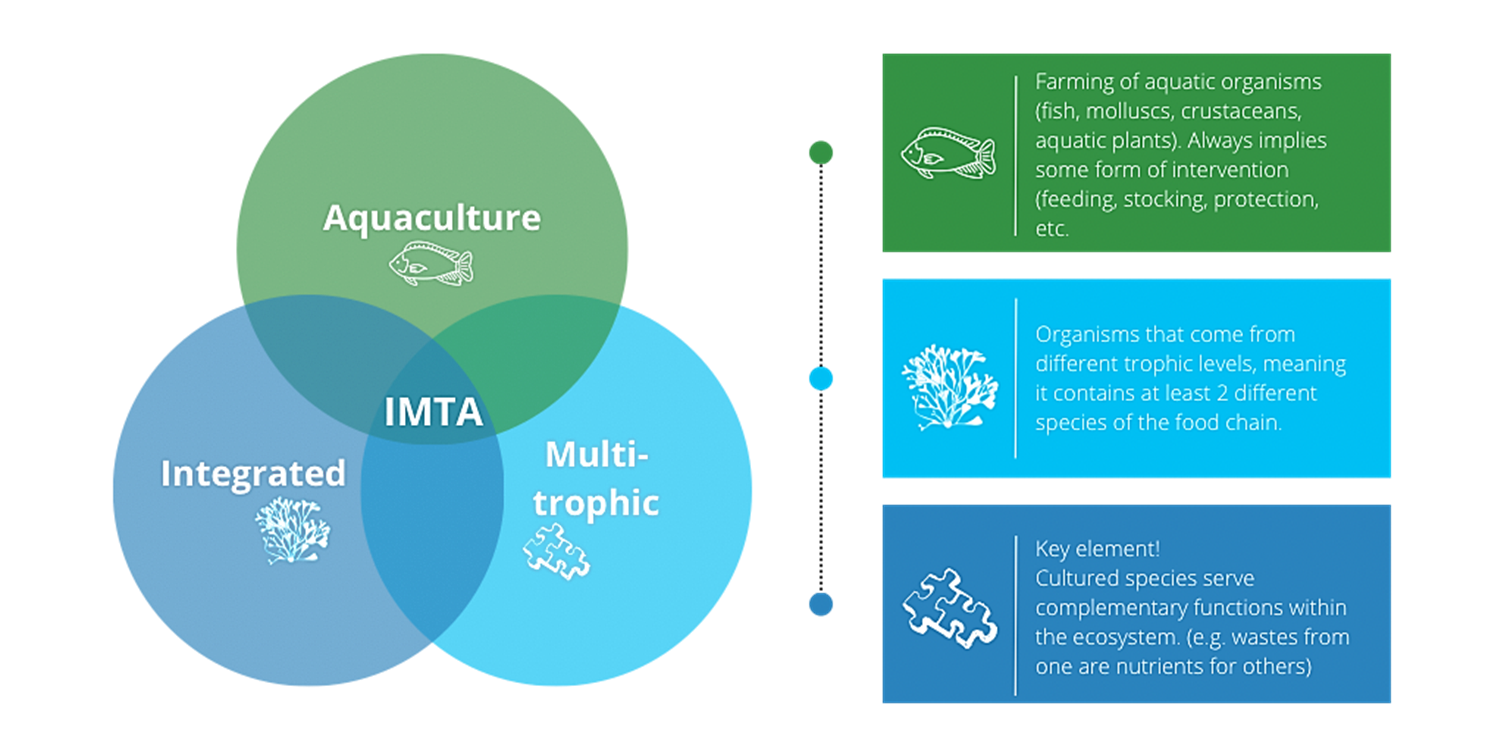
On the left, a venn-diagram of three circles, showing IMTA in the center. The top circle is aquaculture, the left integrated, the right multi-trophic. On the right, three text fields, each explaining aquaculture, integrated, and multi-trophic, respectively. Aquaculture: Farming of aquatic organisms (fish, molluscs, crustaceans, aquatic plants). Always implies some form of intervention (feeding, stocking, protection, etc.) Integrated: Key element! Cultured species serve complementary functions within the ecosystem. (e.g. wastes from one are nutrients for others) Multi-trophic: Organisms that come from different trophic levels, meaning it contains at least 2 different species of the food chain.
The 'Aquaculture' element is the farming of aquatic organisms.
The 'Multi-Trophic' element means that the species must come from different levels of the food chain. In a simple food chain, the base of the chain is plants that use sunlight to create energy so that they grow —seaweeds and other algae are examples. The animals that feed on these primary producers, such as shellfish like mussels and oysters, would be the next trophic level up —these grow by eating the primary producers, the plants, or micro-algae. Then the energy passes up the chain as animals eat each other. Fish are higher up the food chain again. This is what we mean by trophic levels.
So, the Multi-trophic element means that the organisms should come from different trophic levels —at least 2 trophic levels. It should be noted that the food chain in water differs to that on land, that on land much of the primary productivity —leaves and plants— is not utilized and goes to waste, whereas in aquatic environments the vast bulk of the primary productivity is utilised by organisms further up the food chain.
The ‘Integrated’ element suggests that the species farmed are linked to each other in some way, serving complementary functions within the ecosystem. This is the key element of successful IMTA; the species from different trophic levels are farmed together in such a way that they are complementary to each other.
The idea is that the organic and inorganic waste from one species serves as nutritional inputs for the other species. This waste from one cultured species are reused to serve as nutritional inputs for others, reducing or eliminating the waste as it is now a useful by-product or could be called a co-product.
The arrangement of an IMTA set-up can be very diverse. Variations of IMTA include aquaponics of freshwater IMTA, agriculture aquaculture -where the nutrient input comes from agricultural species, biofloc, green water and numerous other variations. There is not one ideal IMTA system, it is a concept that can be applied to specific scenarios.
 On the left, a venn-diagram of three circles, showing IMTA in the center. The top circle is aquaculture, the left integrated, the right multi-trophic. On the right, three text fields, each explaining aquaculture, integrated, and multi-trophic, respectively. Aquaculture: Farming of aquatic organisms (fish, molluscs, crustaceans, aquatic plants). Always implies some form of intervention (feeding, stocking, protection, etc.) Integrated: Key element! Cultured species serve complementary functions within the ecosystem. (e.g. wastes from one are nutrients for others) Multi-trophic: Organisms that come from different trophic levels, meaning it contains at least 2 different species of the food chain.