Joining political parties, trade unions or advocacy groups
Joining a political party, a trade union, or an advocacy group is a powerful way to make your voice heard, stand up for your rights, and connect with others working toward common goals.
Collective action can be more impactful in shaping local and national decisions, and can support change that benefits many communities — including migrants.
In addition to large national organisations, many migrant-led groups and grassroots community networks play a vital role in advocating for migrants’ rights and social justice.
Trade Unions
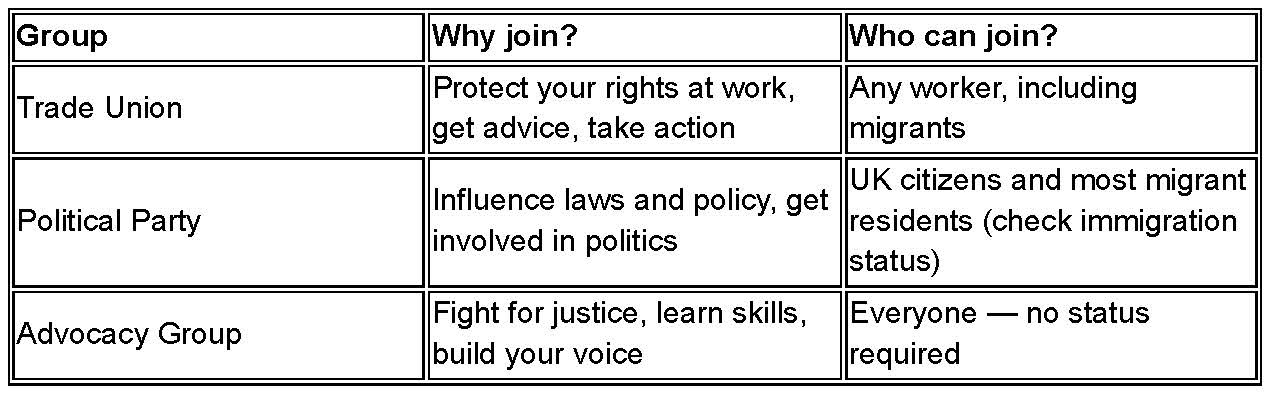
Trade unions are organisations that represent workers and defend their rights at work. They can help you challenge unfair treatment, negotiate better pay, and ensure workplace safety.
Many migrants have jobs in areas like social care, cleaning, hospitality, and farming—where unfair treatment is more likely. Trade unions can help protect workers in these jobs, but not many migrant workers in the UK are union members.
“Levels of [trade union] membership among migrants are lower than those employees who were born in the UK, although levels rise as time spent in the UK increases. Low levels of membership are particularly apparent among migrants from A8 and A2 countries, for whom union membership is approximately a third of the UK average.” (Davies et al. 2016)
There are several benefits of joining a trade union, such as workplace advice and legal support, protection from discrimination and dismissal, support at disciplinary or grievance hearings, access to training, and collective power to push for better conditions.
Finding the right union for the job or sector is the first step for migrants looking to join. For example, UNISON is for public services, GMB for general workers and RMT for transport.
Political Parties
Political parties create and influence laws, policies, and decisions at local and national levels. Being part of a party allows you to shape the political agenda. Membership offers the chance to vote in internal elections, attend meetings, and influence party policies. Some people go on to stand for public office.
Migrants across Europe are less likely to join political parties than those without a migrant background (Bozhinoska Lazarova et al. 2024).
Many countries deny migrants the opportunity to join a political party or to form a political association.
In the UK, most political parties welcome anyone to join. However, participation rights like voting or standing as a candidate varies depending on immigration status. People seeking asylum can often join a political party but cannot vote in internal elections or stand as a candidate. EU citizens may be able to stand for election as a local councillor, but not as an MP.
Advocacy Groups
Advocacy groups campaign on various issues, such as human rights and migrant justice. They often support marginalised communities and work to influence government and public attitudes.
These groups offer a welcoming space to learn new skills, build confidence, and take part in campaigns on issues that matter to migrants.
Anyone, including migrants, can join an advocacy group. Organisations like the3million and Migrant Voice are examples of some of the migrant-led advocacy groups in the UK.
Key benefits of joining include building community power, being able to campaign and influence decision-makers on issues such as fair immigration rules, learning new skills like public speaking, storytelling or lobbying, and meeting others with shared goals.
Migrant engagement with advocacy groups can often be a stepping stone to other ways of engaging with democracy, such as joining a political party.
Summary table