
Sources of collagen
Traditional sources of collagen include the skin of pigs and cows, alternatives to these sources include mainly fish and poultry. Marine collagens are being used increasingly as alternatives to mammalian collagens due to safety reasons or sanitary outbreaks (bovine spongiform encephalopathy), cultural (pescetarians), or religious constraints (Halal, Kosher).
Marine collagen is principally obtained from the skin of different fish species including teleost and chondrichthyans, although it has also been extracted from other sources such as bones, fins, or scales and also from invertebrates such as sponges or jellyfish. To address circular economy principles in the seafood value chain, there is an increasing interest to evaluate the potential of seafood by-products as an alternative and sustainable source for biomolecules such as collagen. In the case of Aquaculture, GAIN has investigated the potential for collagen extraction of different aquaculture species and by-products (Figure 8).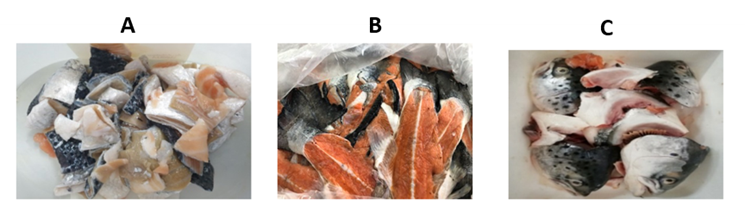
Figure 8. Atlantic Salmon (Salmo salar) by-products (A) skin (B) trimming and frames (C) heads used for collagen extraction and characterisation.
By-products from aquaculture fish for collagen production
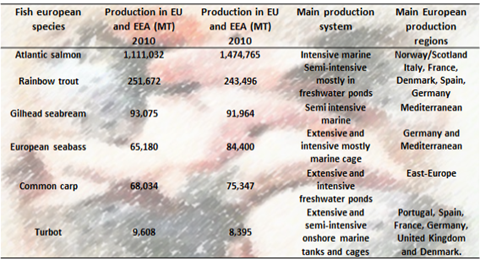
The most important European aquaculture finfish species in terms of volume are Atlantic Salmon (Salmo salar), Rainbow Trout (Oncorhynchus mykiss), European Seabass (Dicentrarchus labrax), and Seabream (Sparus aurata). Other species such as Common Carp (Cyprinus carpio) and turbot (Scophthalmus maximus) are important for eastern countries or remains as a niche species4. Table 1 below shows the production in both EU + EEA countries for these species, together with the main production system5.
Table
1.
European (EU and EEA) aquaculture fish species categorised by production volumes, systems, and country (Adapted from FAO, 2020)