Algae drying techniques
Oven drying
Oven drying has various advantages. Firstly, it creates a controlled atmosphere in which temperature and drying time can be carefully controlled. By facilitating consistent and repeatable drying conditions, this management guarantees uniform drying across the biomass. Furthermore, oven drying is a simple and readily available technique, making it suitable for small-scale research or industrial applications. The temperature utilised in oven drying is critical to achieving maximum drying efficiency. Temperatures ranging from 40 ◦C to 70 ◦C are commonly used, depending on the specific features of the microalgae to be dried. Lower temperatures are generally favoured for heat-sensitive microalgae to prevent bioactive chemical destruction, whereas higher temperatures can hasten the drying process. It is critical to establish a compromise between drying efficiency and the preservation of desired microalgae biomass properties. When employing oven drying for microalgae, there are a few things to consider. To start with, care must be taken to avoid overheating microalgae since excessive heat might result in nutritional loss or the breakdown of bioactive compounds. Monitoring the drying process and ensuring that the temperature stays within the acceptable range for the individual microalgae species being dried is also critical.
Sun drying
This is a traditional method of drying microalgae biomass that uses natural solar energy to eliminate moisture from the algae. Conventionally, it entails spreading a thin layer of microalgae biomass on a suitable surface, such as concrete or mesh, and exposing it to sunlight for a set amount of time. One of the key benefits of sun drying is its ease of use and low cost. It requires little infrastructure and equipment, making it suitable for small-scale operations or places with limited resources. Sun drying also uses sustainable solar energy, removing the need for external heat sources or power use, thereby contributing to its environmental sustainability. Sun drying is especially good for microalgae that are resistant to heat and sunshine. Some microalgae, such as Spirulina and Dunaliella, are naturally adapted to high light conditions and can withstand continuous sunshine exposure without causing major damage to their bioactive chemicals or nutritional value. In such circumstances, sun drying provides moderate and natural drying conditions, retaining the functional qualities of microalgae. When employing sun drying for microalgae, there are a few things to bear in mind. To begin, the drying process is strongly dependent on meteorological conditions, particularly the strength and length of sunshine. As a result, solar drying may be impractical in areas with unpredictable or unfavorable weather patterns. Furthermore, drying time for microalgae can be longer than for other drying methods because it is affected by ambient temperature, humidity and airflow. To avoid over-drying or spoiling, appropriate monitoring is required. Furthermore, exposing the microalgae biomass to the open environment during sun drying may expose it to potential pollutants such as dust, insects or bacteria. Adequate precautions should be taken to safeguard the drying biomass from these external forces and ensure the dried product’s quality and safety.
Drum drying
The process of microalgae drum drying entails the passage of microalgae biomass through a heated rotating drum to eliminate moisture content. The methodology being discussed is a continuous and industrial scale drying method that has been derived from traditional drum drying procedures commonly employed for a range of agricultural commodities. The initial step in the microalgae drum drying process involves introducing the moist microalgae biomass into the drum that is in a rotating state. As the drum undergoes rotation, the biomass is brought into contact with the heated surface, resulting in the evaporation of water from the microalgae. Subsequently, the desiccated microalgae attach themselves to the inner surface of the drum and are subsequently removed in the form of a slender layer or sheet. This material is next subjected to additional processing to provide flakes, granules or powders. One notable benefit of employing the drum drying technique for microalgae is its capacity for facilitating extensive-scale manufacturing. The drum dryer’s ability to operate continuously and handle large volumes of material makes it well-suited for industrial use, particularly in situations when significant amounts of dried microalgae are needed. Moreover, drum drying is a widely recognised and resilient technique, which facilitates its seamless integration into pre-existing processing systems.
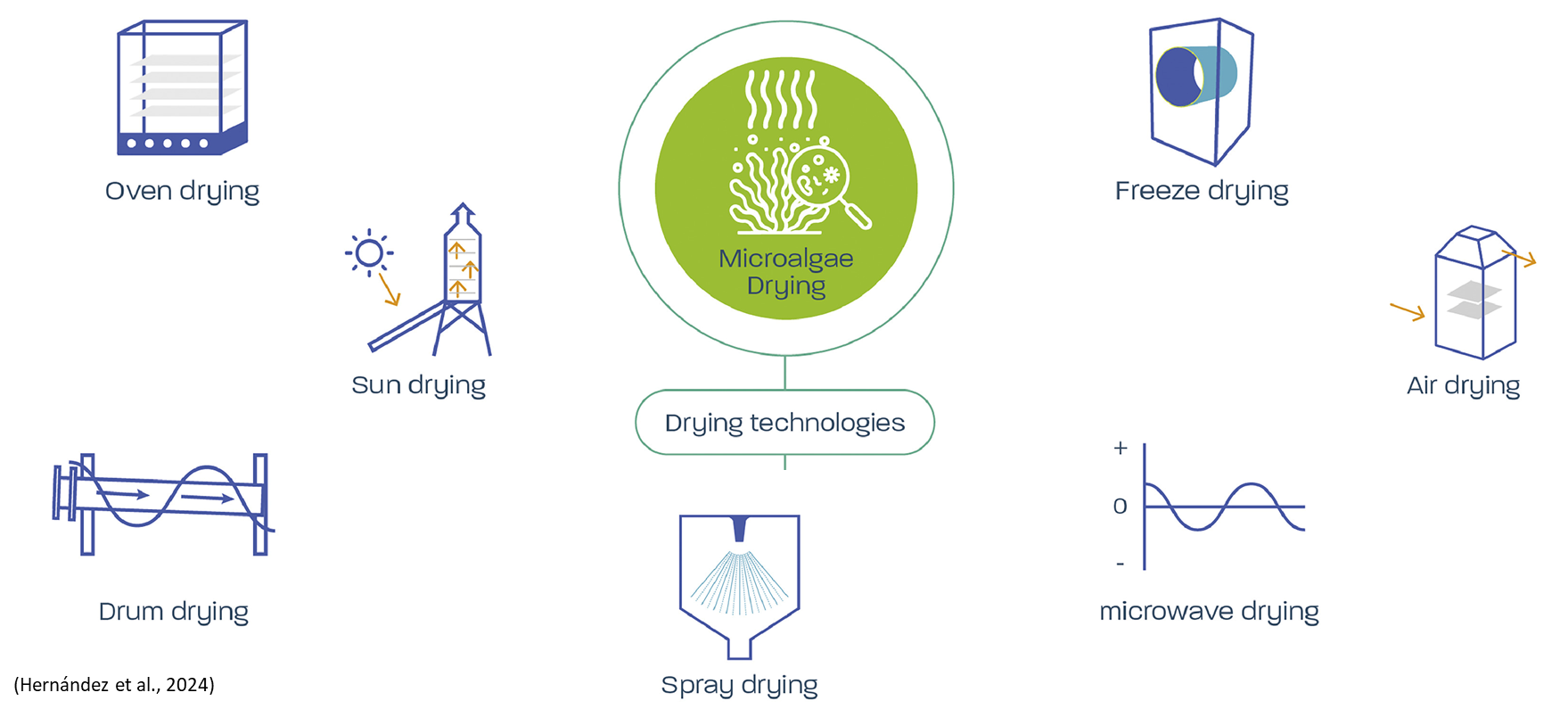 A chart that summarises 7 Drying technologies for Microalgae Drying; Oven drying, sun drying, drum drying, freeze drying, air drying, spray drying and microwave drying.
Freeze drying
Currently, freeze-drying which is often referred to as lyophilization, is a highly sophisticated and widely recognised method utilised for the dehydration of microalgae biomass. The procedure consists of cryopreserving the microalgae by exposing them to low temperatures, followed by placing the frozen biomass in a vacuum environment. This facilitates the sublimation of ice from solid to vapour state without passing from the liquid phase. The process of freeze-drying presents numerous benefits in terms of preserving and utilising microalgae in diverse industrial sectors. One of the key benefits associated with the microalgae freeze-drying process is its capacity to effectively maintain the biological activity, nutritional content, and bioactive substances inherent in the microalgae. In contrast to alternative drying techniques that subject the biomass to elevated temperatures, freeze-drying functions under low temperature conditions, hence reducing the potential for heat-induced degradation of delicate constituents. Freeze-drying, as a process, yields a product that possesses a notable degree of porosity and reduced weight, hence facilitating its manipulation, transportation and storage. The desiccated microalgae powder exhibits an increased shelf life and can be promptly reconstituted as required, hence offering ease and adaptability across several applications. Furthermore, the reduction in water activity attained through the freeze-drying process hinders the proliferation of microorganisms, hence improving the shelf life and safety of the dehydrated microalgae. Although freeze-drying presents notable benefits, it is important to acknowledge certain problems that may arise. The procedure is characterised by its significant time and energy requirements, mostly attributable to the essential freezing and sublimation phases. The optimisation of many process parameters in freeze-drying, including the freezing rate, drying temperature and pressure, plays a crucial role in attaining a high-quality product while simultaneously reducing processing time and energy usage.
Air drying
The process of air-drying microalgae is a commonly employed and straightforward technique for extracting moisture from biomass derived from microalgae. Using this technique, microalgae are dispersed in a thin layer or positioned in appropriate containers and subjected to the surrounding atmosphere to facilitate the inherent process of water evaporation. Air drying is a widely employed method in various research settings, ranging from small-scale investigations to major industrial applications, owing to its widespread availability and economic viability. A key advantage of air-drying microalgae is its remarkable energy efficiency. In contrast to alternative drying techniques that need external heat sources or energy-intensive machinery, air drying exclusively utilises ambient air to extract moisture. This characteristic renders it as a sustainable and cost-effective alternative for the dehydration of microalgae biomass. In addition, the use of air-drying methods helps to preserve the maximum quantity of polyunsaturated fatty acids, particularly docosahexaenoic acid (DHA). It also mitigates the potential for heat-induced destruction of heat-sensitive components, hence safeguarding the integrity of the nutritional and bioactive attributes inherent in microalgae. Air drying provides a favourable environment for the gradual and delicate drying process, hence offering potential advantages for specific species of microalgae.
Spray drying
It is a sophisticated and adaptable approach with enormous potential for numerous sectors such as chemical (fertilisers, detergents), pharmaceutical (drugs), and food (drying milk) industries. A liquid microalgae suspension is atomised into tiny droplets for spray drying, which is followed by a quick drying process using hot air or gasin a drying chamber. This method has become well-known because it can turn microalgae biomass into fine, easily dispersible powders, making it a popular option for many applications. The inlet air temperature, flow rate and feed concentration may all be precisely controlled when drying is performed using spray technology. This degree of control makes it easier to produce microalgae powders that are specifically tailored in terms of moisture content, solubility and particle size. Due to this adaptability, microalgae-based ingredients for functional foods, dietary supplements, and other value-added goods are now being produced. Spray drying offers quick and effective drying, reducing exposure to high heat and protecting the microalgae’s bioactivity, nutritional value, and functional qualities.
Microwave drying
This is a process that employs microwave radiation to generate heat and facilitate the evaporation of water present in microalgae biomass. The microwave drying has attracted considerable interest owing to its capacity to accelerate the dehydration procedure while reducing heat exposure, thereby safeguarding the integrity of bioactive compounds, nutritional composition, and functional attributes. The primary advantage of this method lies in its ability to achieve fast and effective drying by specifically targeting the moisture content present within microalgae. The precise and standardised utilisation of microwave energy enables consistent outcomes in the drying process to be attained while mitigating the potential hazards associated with excessive heating or thermal deterioration. The preservation of bioactivity and nutritional value is of utmost importance, especially in the pharmaceutical, food and nutraceutical industries. Microwave drying exhibits a notable reduction in drying duration when compared to traditional techniques, resulting in energy conservation and overall improved efficacy. When compared to other procedures like freeze drying, oven drying, air drying, and sun drying, microwave drying provides unique benefits.