Biorefinery process
Sustainable Biomass Transformation
The sustainable transformation of biomass into biofuels or energy, alongside high-value co-products, is a key strategy for minimizing waste and maximizing revenue. By integrating multiple processing stages, this approach ensures that every component of the biomass is utilized efficiently, creating a circular economy that enhances both economic and environmental outcomes.
Algae Processing Techniques
Algae undergo a series of processing steps to unlock their full potential. Initially, harvesting and drying methods — such as centrifugation, sedimentation, and flocculation — are employed to separate and prepare the biomass. Following this, extraction techniques, including solid shear, bead milling, cavitation, pulse electric fields, and chemical hydrolysis, isolate valuable compounds. Finally, conversion processes like gasification, pyrolysis, thermal liquefaction, anaerobic digestion, alcoholic fermentation, and transesterification transform the biomass into usable biofuels and energy.
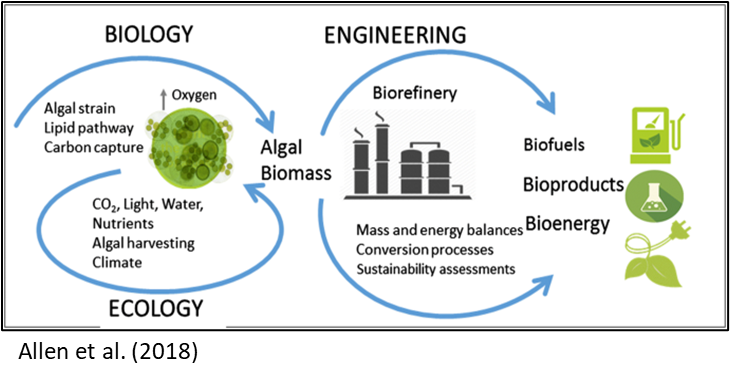 A schematic showing loops that are titled biology, ecology and engineering. Futher details read: algal strain, lipid pathway, carbon capture, CO2, Light, Water, Nutrients, Algal harvesting, Climate, algal biomass, biorefinery, mass and energy balances, conversion processes, sustainability assessments, biofuels, bioproducts and bioenergy
Generations of Biofuel Production
First-generation biofuels, derived from crops or juice grains, offer limited emission reductions compared to fossil fuel-based refineries. Second-generation biofuels, sourced from lignocellulosic biomass, reduce emissions but pose challenges like land and water pollution. In contrast, third-generation biofuels from algal biomass provide a significant reduction in emissions and a lower carbon footprint, making them the most sustainable option. Among biorefineries, algae-based systems hold the greatest potential for producing biofuels alongside bio-based products in integrated supply chains, offering these products at competitive prices.
Economic Viability and Integrated Biorefineries
While biofuel production from microalgae is not yet economically viable based solely on fuel production costs, the integration of high-value co-products—such as food, pharmaceuticals, nutraceuticals, and various forms of energy—can significantly improve financial sustainability. Both macro- and microalgae are promising feedstocks for biorefineries, particularly when structured as integrated biorefineries that produce multiple products. This approach not only enhances commercial viability but also elevates the overall sustainability of algae-based biorefineries.