
Risk assessment matrix
A thorough risk assessment begins with identifying hazards and vulnerable stakeholders, including those who may be indirectly affected, and asking critical questions such as: What could cause harm or sickness to people or the environment? This process involves characterizing hazards and assessing exposure levels to determine whether risks can be minimized or even eliminated. Risks are then evaluated based on their probability of occurrence and the severity of potential harm, allowing for prioritization according to their significance. Once risks are ranked, decisions can be made on preventive actions, which are implemented and continuously monitored. It’s essential to establish protective measures to control and mitigate risks effectively. Additionally, the assessment should be regularly reviewed and updated to incorporate the latest risk evaluation methods and critical measurement techniques, ensuring ongoing relevance and accuracy.
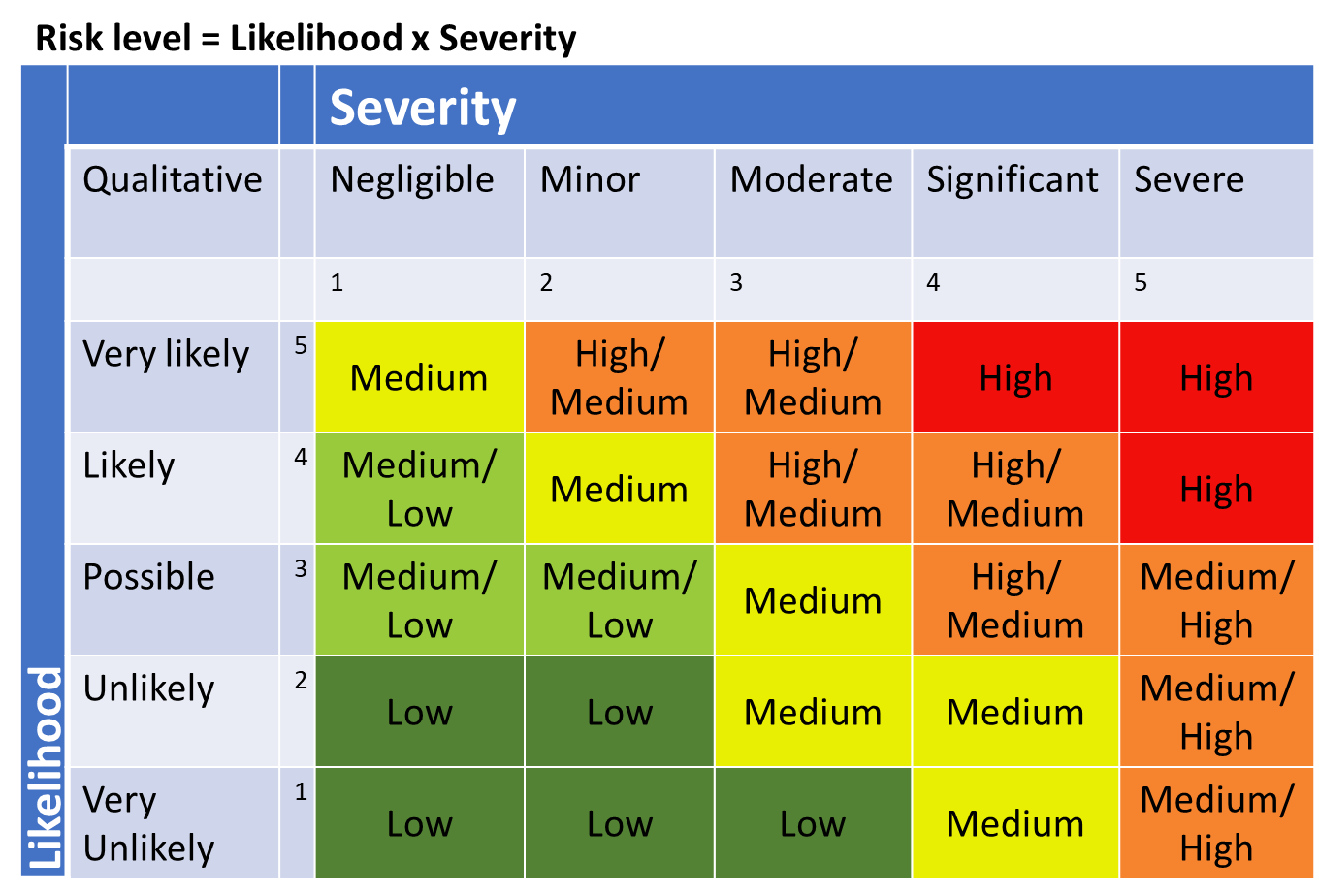 The image shows a risk assessment matrix titled “Risk level = Likelihood × Severity.” The matrix is used to determine overall risk by combining the likelihood of an event occurring with the severity of its consequences. The horizontal axis is labeled Severity and contains five categories: Negligible Minor Moderate Significant Severe The vertical axis is labeled Likelihood and contains five categories: Very likely Likely Possible Unlikely and Very unlikely The matrix illustrates that risk increases as both likelihood and severity increase. For example: A very unlikely event with negligible severity is classified as Low risk while events that are likely or very likely and have significant or severe consequences are classified as High risk.
To streamline this process, tools like the Risk Assessment Matrix provide a visual framework for identifying and prioritizing risks based on their impact and likelihood. This 5x5 grid allows risks to be scored either qualitatively (using descriptive terms) or quantitatively (using numerical values), offering a clear visualization of potential threats. By plotting risks on the matrix, organizations gain a better understanding of different risk types and can focus their attention and resources more effectively, particularly during project planning. The matrix can also be customized - for example, by simplifying it to a smaller grid - to better suit specific needs, making it a flexible and practical tool for proactive risk management (see also).