Hydrothermal Liquefaction for Microalgae
Hydrothermal Liquefaction (HTL) is a thermochemical conversion method that transforms wet biomass into valuable energy products under high pressure (10–25 MPa) and moderate temperatures (250–375°C). Using algae as a feedstock, HTL efficiently produces liquid hydrocarbon fuel precursors (bio-crude) or gaseous products, making it a versatile solution for bioenergy production. One of its key advantages is the ability to skip the energy-intensive drying step, which significantly improves process efficiency and sustainability.
To optimize bio-crude yields, co-solvents like isopropyl alcohol or catalysts such as metal oxides can be introduced during HTL. While these additions boost production efficiency, they also influence the emission profile of the process, requiring careful consideration of environmental trade-offs. Despite this, HTL remains a promising technology, particularly for wastewater-derived algae, which are unsuitable for food applications but can be effectively valorized into biofuels and other energy products.
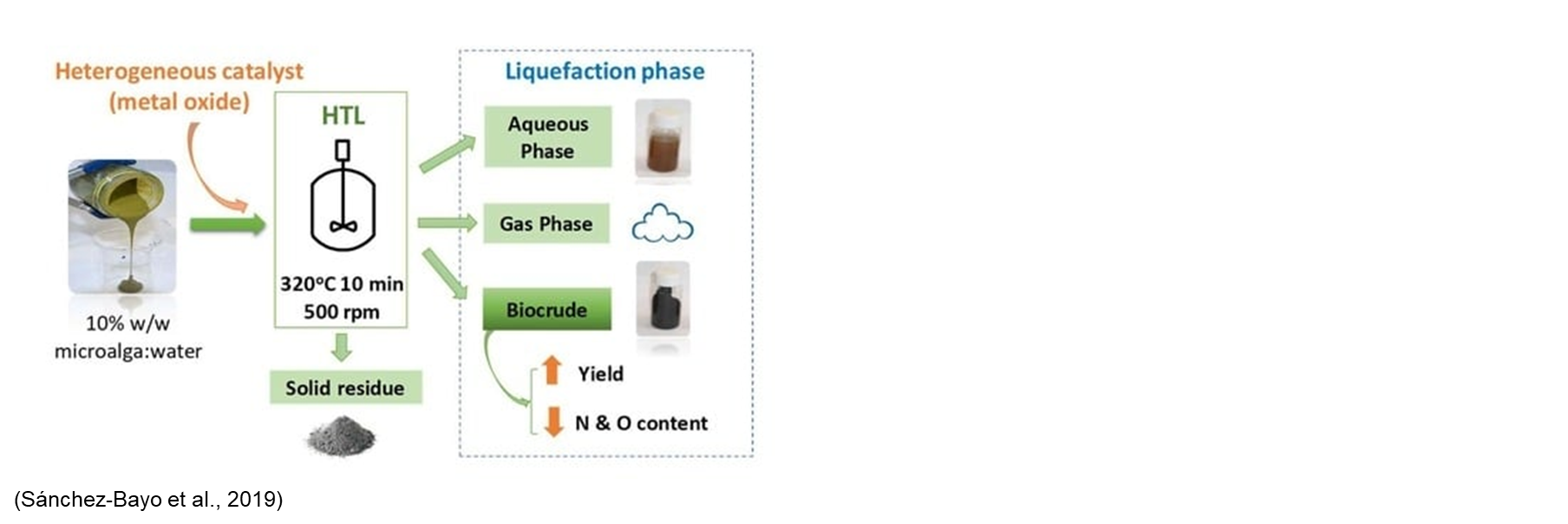 A schematic of Hydrothermal liquefaction (HTL). on the left is a small photo of a glass of microalgae sludge being poured into a container. It is titled 10% w/w microalgae:water; the center image is a simple representation of HTL, reading: microalgae and heterogeneous catalyst (metal oxide) are added and processed at 320 degrees for 10 minutes at 500 rounds per minute. The results are a solid residue and the liquefaction phase, which reads: Aqueous phase, gas phase and biocrude
HTL holds particular promise for wastewater algae, as it provides a sustainable pathway to convert non-food biomass into useful energy resources. By avoiding the need for drying and leveraging wet feedstocks, HTL reduces operational costs and energy demands, making it an attractive option for large-scale bioenergy production. This approach not only supports waste management but also contributes to a circular economy by transforming underutilized biomass into high-value bio-crude and gaseous fuels.