Authorization and notification
Authorization for a Novel Food in the European Union is granted only if the applicant provides sufficient evidence demonstrating that the food or ingredient does not pose a danger or health concern to consumers, does not mislead them, and does not create a nutritional disadvantage—particularly if it is intended to replace a traditional food or ingredient. This evidence can be drawn from existing scientific studies and literature, or from studies specifically initiated or conducted by the applicant. While the application process itself is free of charge, gathering the necessary data and conducting studies can incur significant costs for the applicant.
For traditional foods from third countries, a streamlined notification process exists to facilitate quicker market access in the EU. To qualify, the applicant must provide documented evidence proving at least 25 years of safe use in the country of origin, supported by compositional data and a history of continued consumption. This process applies to a wide range of products, including plants, animals, microorganisms, algae, fungi, and cell or tissue cultures. EFSA has developed a guidance document to assist applicants in navigating the notification and authorization requirements for traditional foods.
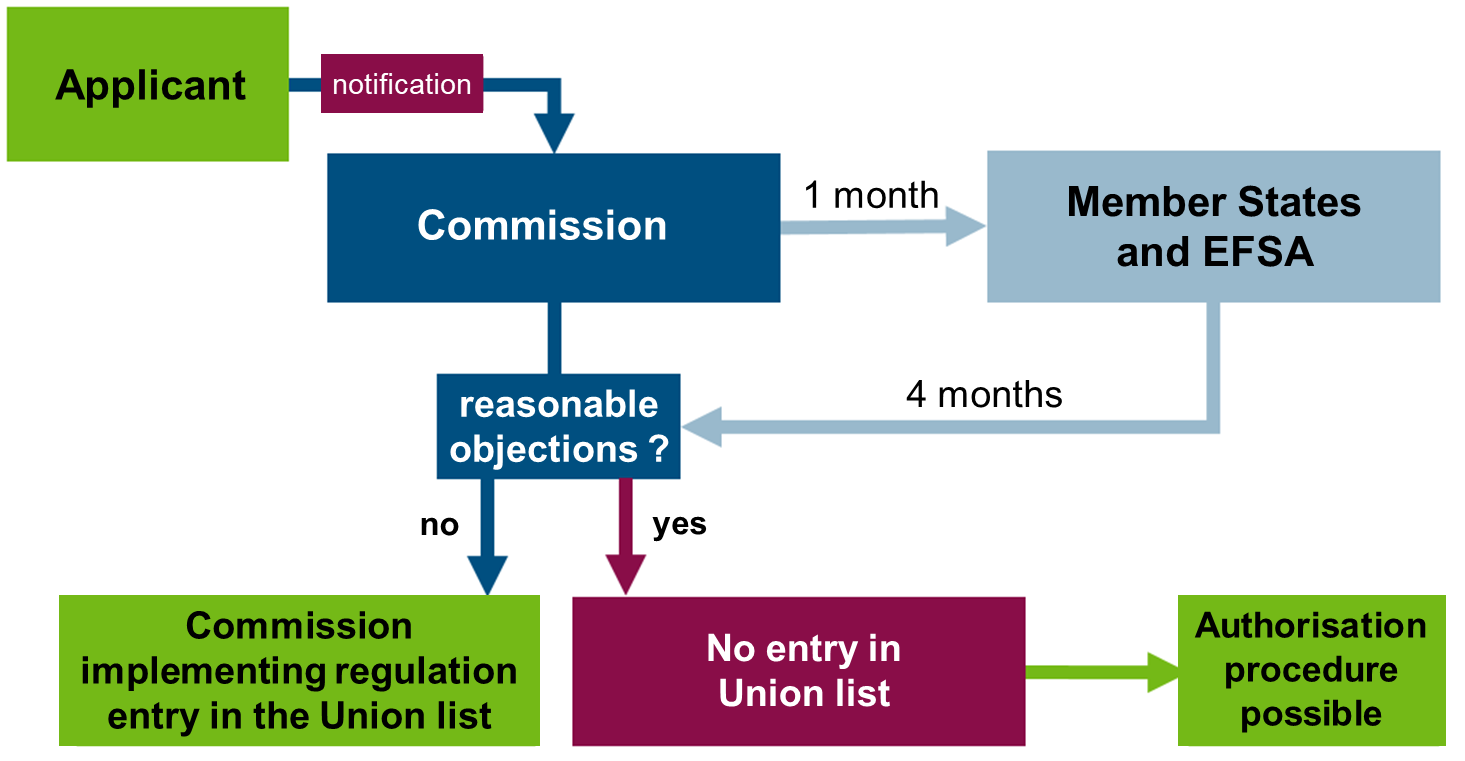
The diagram illustrates the notification procedure for traditional foods from third countries under the European Union regulatory framework. An Applicant submits a notification to the European Commission for a traditional food with a documented history of safe use outside the EU. The Commission reviews the notification and, within 1 month, forwards it to EU Member States and EFSA (European Food Safety Authority). Member States and EFSA have 4 months to assess the information and determine whether there are any reasonable safety objections to the food's proposed market entry. The process then branches depending on the outcome: No reasonable objections: The Commission adopts an implementing regulation, and the food is added to the Union List of authorized foods. Reasonable objections raised: The food is not entered into the Union List through the notification procedure. If objections are raised, the applicant may still pursue a full authorization procedure, which involves a more comprehensive assessment before a final decision can be made. Original from BVL.
Traditional foods from third countries may gain faster access to the EU market if they meet the 25-year safe-use requirement. Once a notification is submitted, it is forwarded to EFSA and Member States within one month. Over the following four months, Member States and EFSA can raise any reasoned safety concerns. If no objections are raised, the food is added to the Union list and can be marketed in the EU. However, if objections arise, the food cannot be listed through this notification process, and the applicant must instead pursue a full authorization procedure.