
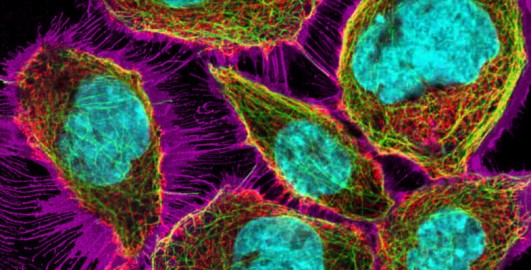
Exploring cells with digital fluorescence microscopy
Introduction
For centuries, humans have wondered what lies beyond what we can see. With the invention of the microscope, we unlocked an entirely new dimension, revealing the delicate architecture of cells, the vibrant complexity of bacteria, and even the atoms that build our world. Microscopy is not just a tool, it’s a portal into the hidden stories of life, science, and discovery. This powerful technology has transformed our understanding of biology, medicine, and materials, and continues to push the boundaries of what is possible.
But what if we wanted to do more than just see? What if we wanted to highlight specific parts of this hidden world, make them glow, move, and tell their own stories? That’s where fluorescence microscopy comes in.
Fluorescence microscopy doesn’t just show us what’s there, it lets us light up the inner workings of life in stunning colours. By tagging molecules with fluorescent markers, we can track proteins inside cells, follow the spread of disease, or even watch neurons communicate in real time. It’s like turning on the lights in a dark room and discovering not just objects, but activity, interaction, and purpose.
This course will explore how this glowing frontier of microscopy is helping us unlock secrets at the cellular level and pushing science to new and exciting frontiers.
You will begin by building a solid foundation in the basic principles that underpin microscopy. From there, you will get a brief overview of the various types of microscopy and how they reveal different aspects of the microscopic world. Then, the course will dive deeper into the captivating realm of fluorescence microscopy, where glowing markers bring cellular processes to life in vivid detail. Along the way, you will revisit key cellular structures through an interactive 3D cell model, before applying your knowledge in the final section by exploring real biological samples using a digital fluorescence microscope.
Throughout the course you will encounter many micrographs, images taken with a microscope, and some videos that illustrate the power of microscopy. Questions and quizzes will help you to test your understanding throughout the course.
To gain maximum benefit from the course, you should have a basic understanding of the structures you can find inside cells. The free OpenLearn course ‘A tour of the cell [Tip: hold Ctrl and click a link to open it in a new tab. (Hide tip)] ’ can help you to acquire or deepen this knowledge. It also shows many images taken with electron microscopy, perfect if you are curious about this technique. If you are interested in exploring light microscopy in more detail including how to stain samples for histological examination, the free OpenLearn course ‘Histology, microscopy, anatomy and disease’ may also be of interest to you.
This OpenLearn course is an adapted extract from the Open University course S296 Cell and molecular biology.