
5.4 Specialised applications: Studying molecular dynamics
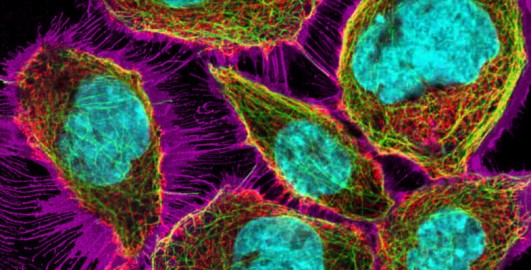
Fluorescence microscopy can also be used to investigate real-time molecular interactions and dynamics within live cells. Two commonly used techniques are:
- Fluorescence Resonance Energy Transfer (FRET): measures the energy transfer between two fluorescent molecules in close proximity, allowing researchers to study protein–protein interactions, conformational changes, and signal transduction pathways at the nanoscale.
- Fluorescence Recovery After Photobleaching (FRAP): involves irreversibly bleaching a region of fluorescence and monitoring the movement and replacement of fluorescent molecules into that region over time. This helps in understanding protein mobility, membrane fluidity, and molecular binding dynamics.