
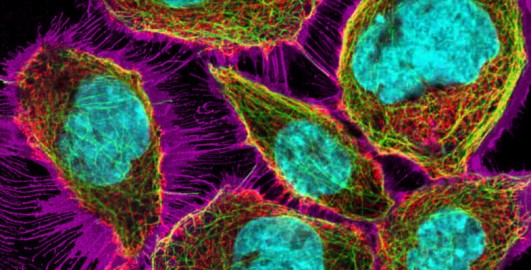
5.5 Specialised applications: Super-resolution microscopy
Traditional light microscopy is limited by the diffraction of light, which restricts resolution to around 200 nanometres. Super-resolution microscopy breaks this barrier by using advanced optics, fluorescent molecule behaviour, and computational techniques to achieve resolutions as fine as ~25 nanometres. This allows researchers to visualise structures previously invisible with standard fluorescence methods. Key techniques include:
Structured Illumination Microscopy (SIM): projects a patterned light grid onto the sample and reconstructs images computationally. SIM doubles resolution (to ~100 nm) and is ideal for live-cell imaging due to its low light exposure.
STORM (Stochastic Optical Reconstruction Microscopy): uses randomly blinking dyes to localise individual molecules and reconstruct ultra-high-resolution images of fixed samples.
PALM (Photoactivated Localization Microscopy): similar to STORM, but uses photoactivatable fluorescent proteins, achieving comparable resolution (~20–30 nm).
Each technique offers unique advantages, expanding what can be visualised at the molecular level and enabling deeper insight into cell structure and function.
Super-resolution microscopy was able to achieve a resolution of ~25 nm when this course was written, which is far beyond the limit of light microscopy.
Which cellular structure with a diameter of ~25 nm can you think of, that you could visualise with super-resolution microscopy?
Answer
Ribosomes have a diameter of ~25 nm, and you learned earlier that you need the resolution of an electron microscope to visualise these.
When visiting the digital fluorescence microscope, you will see slides of various cellular structures. Prior to that you now have a chance to inspect an interactive 3D cell to get a reminder about the function and localisation of different structures. After that, you’ll be introduced to the digital fluorescence microscope.