
5 Why is fluorescence microscopy so versatile?
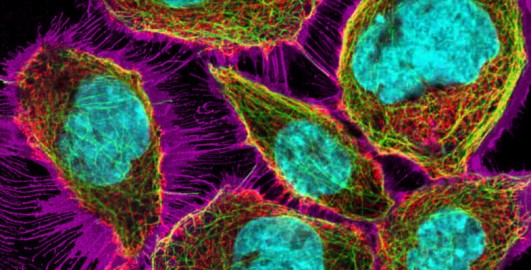
The remainder of this course will focus on fluorescence microscopy, widely regarded as one of the most versatile techniques for visualising cells and proteins. Here are the key reasons for its versatility:
Specificity: fluorescent dyes or proteins can label specific structures, organelles, or molecules, such as DNA, mitochondria, or individual proteins. Using antibodies (immunolabelling), researchers can target virtually any protein of interest.
Multiplexing: different fluorescent dyes emit light at different wavelengths, thus allowing multiple targets to be visualised simultaneously in different colours within the same sample.
Compatibility with other techniques: fluorescent microscopy could be combined with molecular and genetic techniques to visualise genetically engineered proteins inside cells.
Live-cell imaging: the main benefit of the above compatibility is that researchers can track dynamic processes such as the expression or the movement of a protein, the behaviour of an organelle in living conditions.
Enhanced capabilities: different types of fluorescent microscopy (such as confocal microscopy) offer some important enhancements.
Quantification and analysis: fluorescence intensity can be measured, allowing for quantitative data collection on things like protein concentration, gene expression levels, or ion concentrations.
The following sections provide a bit more insight on the points mentioned above.