
6 Inspecting structures in a 3D cell
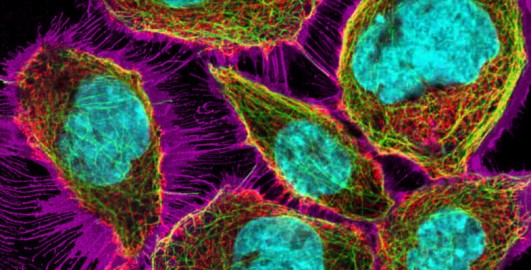
The interactive 3D animal cell below helps you to see the arrangement of animal cell components.
Select each cell component from the drop-down list to read explanations.
Click on the micrographs to see the structures in more detail.
When you have explored the whole cell, attempt the following questions.
Question 1
Based on your observations in the 3D interactive cell, put the following structures into the correct order from the largest to the smallest.
Using the following two lists, match each numbered item with the correct letter.
-
nucleus
-
mitochondria
-
nucleolus
-
secretory vesicle
-
ribosomes
Match each of the previous list items with an item from the following list:
a.(largest)
b.
c.
d.
e.(smallest)
- 1 = a,
- 2 = c,
- 3 = d,
- 4 = b,
- 5 = e
Question 2
What is the name of the membrane system that begins at the nuclear envelope and spreads throughout the cell?
Answer
The endoplasmic reticulum (ER). The nuclear envelope is continuous with the rough ER (RER), which is studded with ribosomes on its outside. Further away from the nucleus, the RER continues into the smooth ER (SER), which no longer has ribosomes on its membrane. You will see different shapes of the ER when inspecting slides in the digital fluorescence microscope.
Question 3
What are the three main components of the cell membrane?
Answer
Lipids, mostly phospholipids (forming a lipid bilayer), membrane proteins and sugars. The sugars are attached to proteins (forming glycoproteins) or lipids (glycolipids). When inspecting cells in the digital fluorescence microscope, you will see that the cell membrane is not smooth, but has many extensions.
Question 4
What is the membrane structure of mitochondria, and which type of microscopy allows studying it?
Answer
Mitochondria are surrounded by a double membrane. The inner membrane is folded into structures called cristae. The space between the inner and outer membrane is called the intermembrane space. The membrane structure can be studied using electron microscopy, which has a high enough resolution to clearly show both membranes.
Question 5
Which specialised organelle in animal cells fuses with vesicles to break down worn-out cell components?
Answer
Lysosomes fuse with vesicles containing old organelles and ingested material and break down the contents.