
1.2 Magnification and resolution are important when studying details
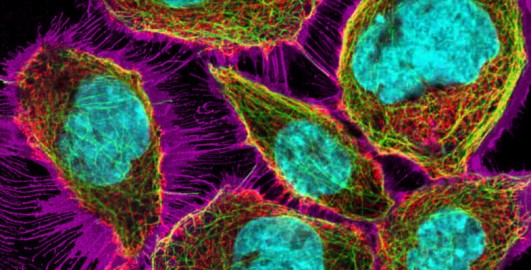
You should now be familiar with the sizes of cells and structures that you will see when using the digital fluorescence microscope. Before you get to that, it’s important to understand the difference between two different terms: magnification and resolution. Magnification describes by how much a microscope or a digital camera can enlarge, or magnify, an object. This increases the size in which you can see a structure – think about the zoom a camera can offer you. However, whilst the structure is enlarged, it might become blurry and you can’t see the details. The ability of being able to separate two neighbouring objects in an image is described with the term resolution (i.e. the two objects can be resolved; they do not appear as a single object). You might be familiar with the concept of resolution from using digital cameras. A camera with more Megapixels has a higher resolution, meaning that it will show more details when enlarging the image compared to an image taken with a camera that has fewer Megapixels. A typical light microscope has a maximum resolution of around 200 nm, whilst electron microscopy can achieve a resolution of around 0.1 nm.
a.
Panel (a)
b.
Panel (b)
The correct answer is a.
a.
Correct. You can identify this because both micrographs are shown with the same magnification and panel (a) shows more details.
So, it’s not just about zooming in (magnification), it’s about how clearly you can see once you’ve zoomed in – and that’s resolution.