Overview
Tree Value Visions (TVV) is a participatory visioning tool designed to support local decision-making on tree management and planting. A full academic description can be found in the open-access paper accompanying this course1.
TVV generates evidence and insight about how trees are valued in a locality, focusing on their current and potential social and cultural values, in the context of statutory duties and instruments. The social and cultural value focus differentiates this tool from others focused on financial or ecological/biophysical metrics. The process of using the tool supports communication and learning between stakeholders and across sectors, including direct community/citizen involvement. It is grounded in best practice around how to form values through group deliberation and participation2-3, and in the environmental values framework adopted by the Intergovernmental Science Policy Platform for Biodiversity and Ecosystem Services (IPBES)4-7.
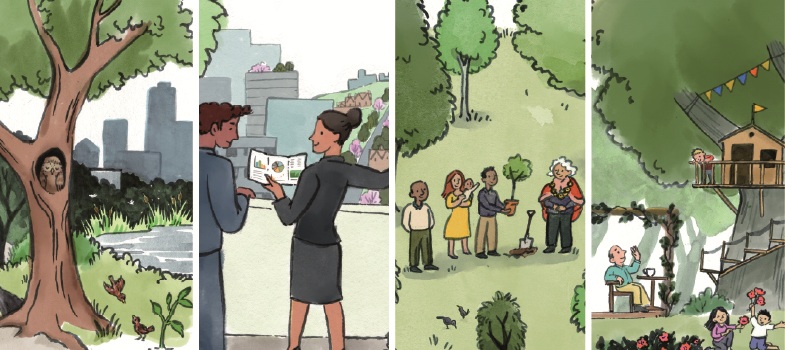
The free-to-use tool addresses the needs of a range of stakeholders and end users. The guidance is written with urban local authority scales, stakeholders and responsibilities in mind, at scales running from authority-wide to ward level areas, or even single greenspaces. The core of the tool is four narratives illustrating different future treescapes, linked to sets of actions and outcomes. The tool also includes a process template how a social valuation can be generated in a single (±3.5 hour long) community stakeholder workshop or citizen panel meeting. Communities are asked to respond to the archetypal ‘visions of the future’ to prompt discussion on how the visions could be translated into local contexts (the local scale is not pre-set and can be adapted by the user) and prioritise social outcomes and policy and management actions across the visions.
The outputs help develop integrated community visions of how to develop and manage urban treescapes in a way that acknowledges and grows the diverse value of trees. The tool takes in biophysical matters of tree management, such as location and care, but also wider considerations such as forms of community involvement, culture, strategic economic development, governance, and health and wellbeing. The process can also incorporate those acting on behalf of nature, e.g. participants acting to represent a voice for trees and wildlife.