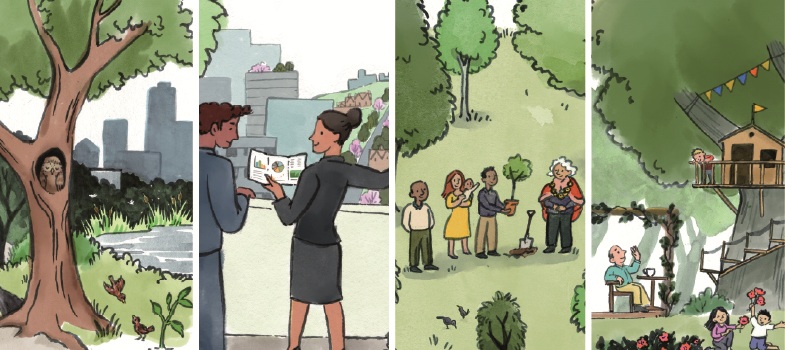
Possible outcomes of future visions - Transport, economy and development
|
Transport, economy and development |
||
|
A similar amount of space continues to be available for cars (road space, parking, etc.), and is not reduced to make more space for trees.
|
Living from |
|
Space is made available for new housing developments, and the roads, public transport, and other infrastructure needed for them. This could mean a loss of trees and reduced space for new trees.
|
Living from |
|
More food consumed in the city is produced locally, directly in and near the city. This includes food linked to trees, such as fruit, nuts and honey.
|
Living from |
|
The city is more attractive to tourism.
|
Living in, living from |
|
There are more jobs in the nature sector, such as in maintaining green space, arts, therapeutic activities in nature, and environmental education. |
Living from |
Notes
These Outcomes may require most explanation, to give examples or delineation of what the focus or consequence is, because they refer to human factors with indirect but systemic implications for trees.
Some sensitivity may be required around the 'space for cars' item. This outcome prompts for continuity (that space for cars is not reduced). The remaining four prompt for change. Given that a key way to achieve many other outcomes in an existing urban area would be to reduce the amount of space for cars, this outcome allows participants to explicitly register that this should be recognised as a constraint. Unlike 'space for housing developments', the rhetoric of continuity in a future-focused activity somewhat differentiates this item from the others. However, given the real-world context, contemporary social trends, and that this was not raised by the original groups of citizens who co-designed the visions, including a prompt inviting more space for cars was not a part of the visions.