Creating a local vision
The intended use of the tool determines whether a local vision is subsequently produced. Our pilot work in Edinburgh and Camden did not produce one, but they were produced in the precursor research on York, Milton Keynes and Cardiff. The majority of the vision would be written by drawing from the original visions, according to the actions (potentially contextualised or framed by the linked outcomes). Further text could be added based on the contents of the survey or in-panel conversation, but this should be a minor proportion, based on areas of significant discussion and consensus.
Read along with the synthesis narrative created by the York panels of Branching Out, as read by Maria Gill, from St Nicks Environment Centre, YorkAudio player: York%20vision.mp3
Underlined text marks verbatim quotes from citizens’ stories of the future. Remaining text drawn from synthesis of Life Frame visions according to priority outcomes and actions.
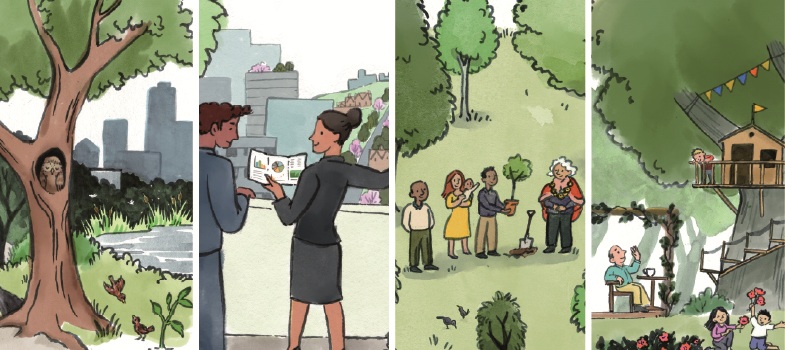
Local residents are meeting to celebrate 25 years since they planted a community orchard together. A child plays with his friends among the blossoms. The orchard, which the child's mother remembers planting when she was a teenager as part of an educational program, now produces fruit that is shared as part of the celebrations.
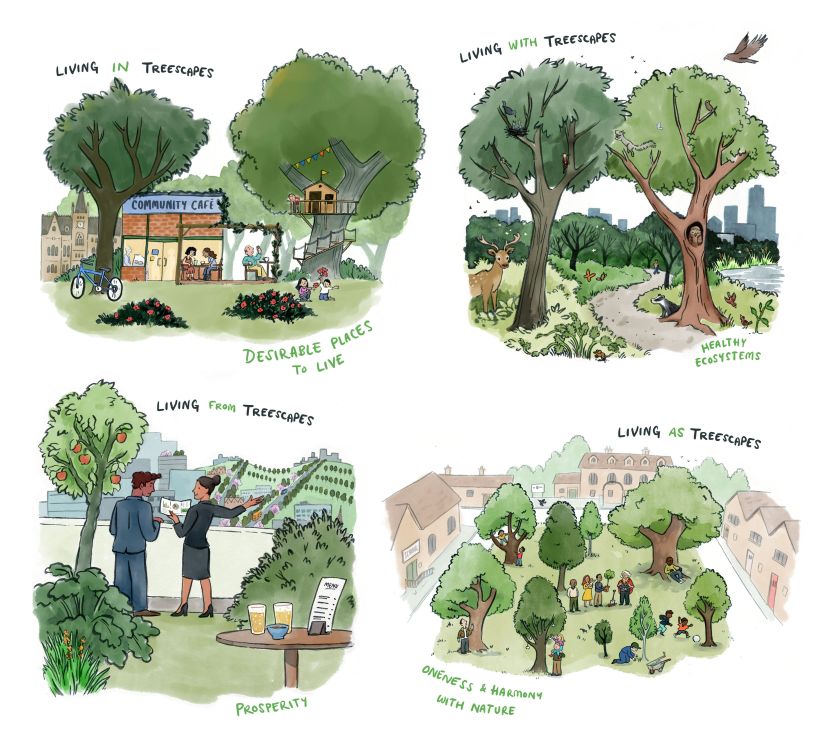
In York, 50 years ago, citizens came together to develop a common vision of future treescapes, much of which has now been realised. Citizens’ top priorities included improving health and wellbeing, equity in access, biodiversity, environmental education, local food production, and regulating ecosystem services (for example, the ways that treescapes help to slow stormwater to prevent floods, protect us from extreme heat and regulate our local and global climate). Increasing the number of small green spaces in the city was core to their vision.
Improving our health and wellbeing involved everyone, from businesses, to the health service and community members. We focused on creating small green spaces for everyone to recreate and meet up with each other, and escape the stresses of life and the heat waves that we get more often now due to climate change. Many people find peace and belonging here and this benefits our mental and physical health.
Green prescriptions are strongly embedded in the health service and there are policies in place that ensure that all hospitals and care homes look out onto green space, speeding up recovery.
Due to new local government policy, everyone in our city now has access to a woodland or park within 300 metres of their home. The inequality that used to be there, where some people would struggle to find accessible green space, is gone.
The small green spaces that help achieve this take many forms: community orchards; a seating area on a street corner or event space where there used to be a derelict site, surrounded by trees; an area of trees in a school field; and many small mixed-age community woodlands dotted around the city that feel like a natural part of the community. Some of the community woodlands are memorial woodlands, where a tree is planted for everyone who dies in the city. The woodland becomes a special place for their family to visit and remember them. In the centre of York, the trees are full of long tailed tits and wag tails, the canopy is full of life with butterflies, bees and other insects buzzing and adding to the music in the marketplace.
Many of the smaller green spaces are managed decentrally through neighbourhood groups, supported by the council’s tree officers. The tree species planted are prioritised by local people, and many communities choose trees that provide colours in the autumn and blossom in the spring. Climate resilience has also been important and we selected species for drought and flood resilience in collaboration between experts and the community.
Nature bridges connect green spaces across main roads, street corners and derelict spaces have been revived into pocket parks or tiny forests, with information boards on the history of the treescape and biodiversity that the spaces provide. Small green spaces are linked up where possible, including through pocket parks, tree lined avenues, and safe green lanes for walking and cycling only, encouraging active travel. Rooftops have also become homes for trees and the city issued a planning requirement that all new developments and existing streets must be treelined unless there are strong overriding impediments.
This way, the city has become a living landscape that has reduced flood risk, added shade and colour, urban cooling and cleaner air and brought an abundance of birds, insects and other wildlife. Tree planting maximises connectivity and biodiversity, with a recognition that trees and the animals and plants that depend on them deserve to be protected for their own sake. Planning in the connected, living landscape has biodiversity as a hard constraint: developments cannot go ahead if they have a significant negative effect on biodiversity or rare species. This has meant that we have had to be very selective in terms of where we’ve been able to expand housing and other development, restricting it to brown field sites and low-grade agricultural land. Thus large houses come at a premium and there are more flats.
Perhaps most important of all, we developed a policy to maximise educational engagement throughout people’s lives. School children engage with trees through planting and pruning trees for tree climbing, den making, foraging and other sensory activities. Forest schools are embedded in every primary school and bushcraft in every secondary school curriculum, supporting parents, and ensuring inclusivity for those with additional learning needs. Many employers in the city now run programmes to support employee wellbeing by providing opportunities to learn the skills to care for the trees as well as providing green views to reduce stress and increase productivity. Agroforestry farms on the edge of the city have provided a new set of career opportunities which local colleges provide training in.
Overall, this led to quite an organic way in which we met government targets for tree planting. What once were derelict areas are now places full of new life. Not only is nature thriving, but people are also given new spaces to socialise and enjoy nature in their own way, with more opportunities for those who had been socially excluded. Our relationships changed – with the trees, with nature, with each other and with ourselves – and we became healthier physically and mentally through nature connection and being outside, more community focused, more sociable, more creative, and with much happier kids.