Conceptual basis and development
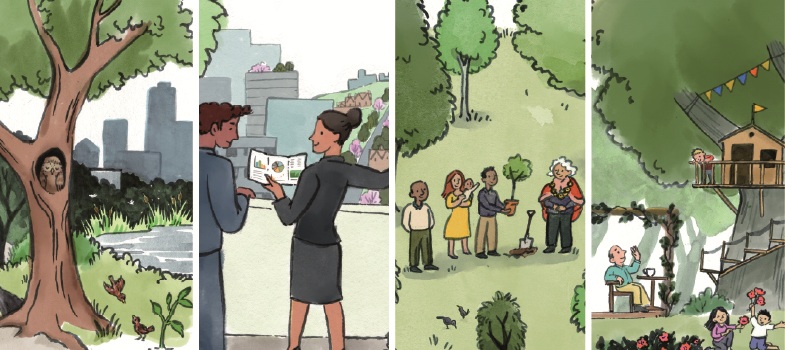
The Tree Value Visions materials are structured across the four IPBES ‘Life Frames’ to holistically and systematically understand how localities relate to the potential social and cultural values of treescapes. The Life Frames, originally based on work by O’Neill et al.7 and O’Connor and Kenter8, 9, have been adopted by IPBES to organise its interdisciplinary typology of nature’s values4-7. Each Life Frame expresses a different way that people and nature relate, and a way of thinking about nature’s values.
The IPBES is the acronym for the "Intergovernmental Science-Policy Platform on Biodiversity and Ecosystem Services". It was established by the United Nations to aid communication between science and policy on the issues contained in its name! The life frames are intended to aid the understanding and valuation of nature across a range of uses.
When applied to treescapes, the four frames are:
- Living in treescapes: trees contributing to desirable places, e.g. in terms of recreation, landscape, culture and heritage;
- Living from trees: trees as a resource, emphasising prosperity and efficiency;
- Living as trees: trees being part of the community, a sense of oneness, and ascribing agency to trees.
- Living with trees: trees as space for nature, emphasising healthy ecosystems.
The life frames were given a UK-localised and applied format by the UKRI Branching Out project (2021-2025, valueoftrees.co.uk). The project prompted representative citizen panels in York, Milton Keynes and Cardiff with the four life frames, eliciting social and cultural values of trees through storytelling and group deliberation over the course of three workshops. Based on local citizens’ and stakeholders’ input, a set of visions, desirable outcomes, and concrete actions were developed. Each city then formulated its own unique vision, drawing locally favoured elements from across the archetypal life frames, and agreeing on priority outcomes and actions that would move the city towards those overall visions.
A follow-on UKRI project, Branching Beyond, adopted the Branching Out outputs into the Tree Value Visions tool for rapid use. The rapid tool was validated and piloted through further citizen panel meetings in Camden and Edinburgh. The course you are studying explains how to use the tool created by Branching Beyond.