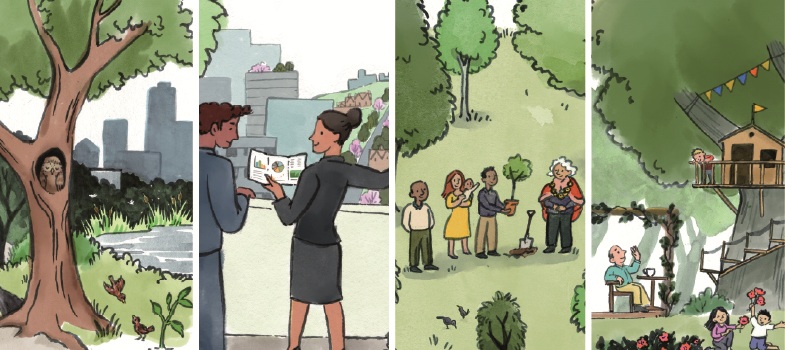
Living IN treescapes
Trees contributing to desirable places to live
Listen to Holly Woo (The Open University) read the 'Living In' visionAudio player: Living%20In%20recording%20%281%29.mp3
In our city, treescapes and trees increasingly became recognised as a defining feature of the places where we live and work and where we spend time with our family and friends. Trees make us feel at home.
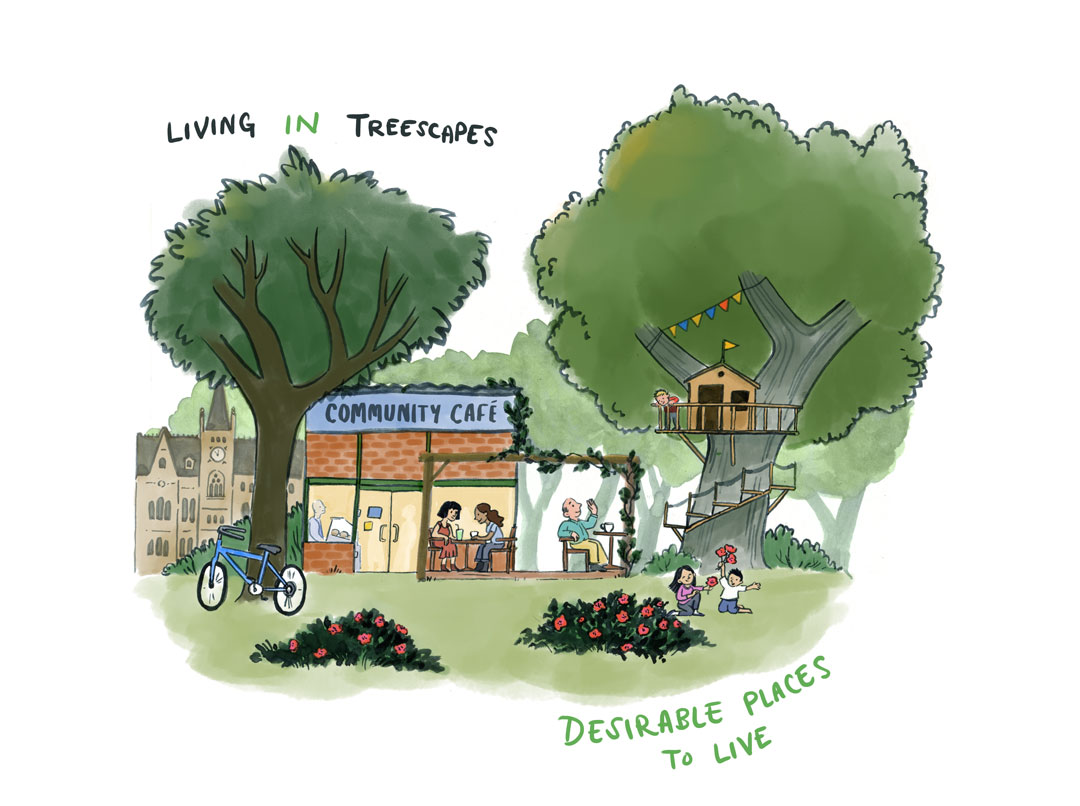
Figure 2: An illustration of the 'living in' vision
Local residents are meeting to celebrate 25 years since they planted a community orchard together. A child plays with his friends among the blossoms. The orchard, which the child's mother remembers planting when she was a teenager as part of an educational program, now produces fruit that is shared as part of the celebrations. Trees planted by the child's grandfather in a nearby garden are tall enough to provide shade and can be seen from many residents' houses. A treehouse has been built in one of the pine trees. The grandfather smiles up at the treehouse, remembering how much joy it brought his daughter, and now his grandson.
Due to new local government policy, everyone in our city now has access to a community woodland or park that is within 200m of their home. Thanks to these targets, the city is greener than it was when the grandfather was young and worked in the city centre. The paved square he used to walk across to get to his office is now a meadow fringed with trees and colourful flowers.
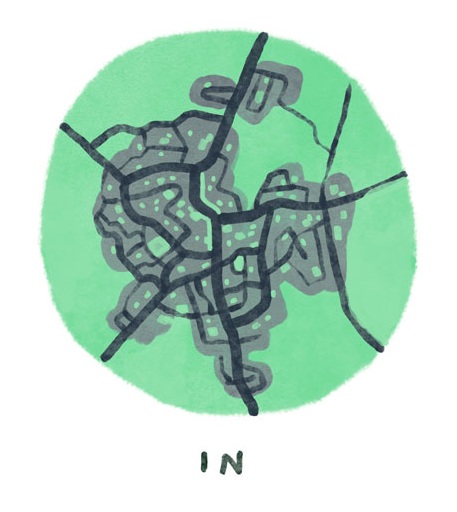
Figure 3: A map of an illustrative city showing strong 'living in' characteristics
We focused on tree planting to create green spaces for everyone, for recreation, to meet up with each other, and to benefit our mental and physical health, escaping the stresses of life and the heat waves that we get more often now due to climate change. The inequality that used to be there, where some people would struggle to find accessible green space, is gone. Green prescriptions are strongly embedded in the health service, and there are policies in place that ensure that hospitals and care homes look out on green space.
We also created a network of green paths throughout the city and put a programme in place to line streets with trees wherever possible. New utilities and broadband cables have gradually shifted to sit under roads rather than pavements to create space for street trees, which does mean that traffic flow is interrupted more often. The rooftops have also become homes for trees, creating new greenspaces in the city centre for people to use and get away from noise and bustle of the pedestrianised streets below.
We developed culture and business plans to take advantage of green spaces, and we have many more cafes, restaurants, outdoor gyms, music and cultural events outdoors, which local people and tourists enjoy alike. Cultural heritage is also important, we’ve strongly protected veteran trees and old treelined lanes because they are so important to our sense of place, and started to think about which trees and lanes might become heritage for future generations.
Many of the smaller green spaces and community woodlands have devolved management through neighbourhood groups, though supported by the council’s tree officers. The tree species planted are prioritised by local people, leading to a diversity of native and non-native species. Many communities choose species that provide colours in the autumn and blossom in the spring. This does mean the treescape is diffuse and focused on amenity, which is not always optimal for biodiversity conservation.
An old willow tree leans over one of the streams providing dappled shade over the water. The willow has seen the landscape change from fields, to town, to urban forest; but tree planting means that this tree is now better connected to the wider treescape. From the laughter and chatter of people enjoying its shade and playing in its branches you can hear how it is providing a home to the people of the city too.