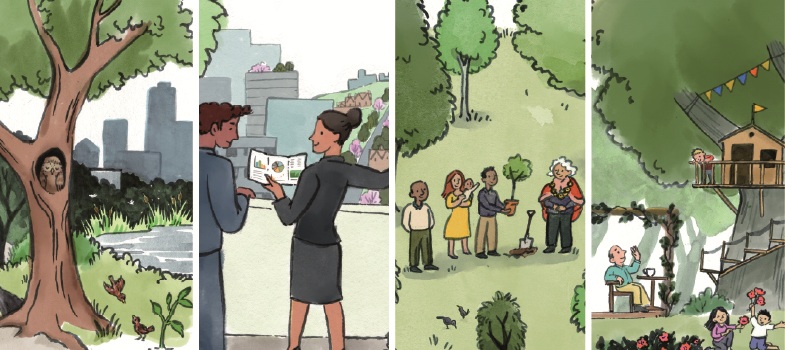
Example applications (1)
- tree management
- culture, heritage and tourism
- biodiversity
- climate change adaptation and mitigation
For tree management, the tool supports identification of social and cultural values that can be met by local treescapes. It is a structured means to comprehensively identify the value of trees, particularly those otherwise taken-for-granted or not sufficiently recognised in existing toolkits and valuation methodologies. The tool could help identify social and cultural value that would otherwise be revealed by subsequent opposition to potential tree removal. It can support the identification of particularly valued treescape forms (trees, forms of maintenance, biophysical characteristics, or sub-localities that produce noted levels or types of value) that might be achieved within the function of meeting Health and Safety responsibilities. It could inform Tree Preservation Orders, and wider treescape management such as the treatment of arisings, conversion of mown grass parkland to woodland or tree-inclusive meadow, habitat/ecosystem/biodiversity considerations, and human benefits.
For culture, heritage and tourism, social and cultural values of trees are often associated with sense of place. These could be those desired by local communities and incorporated into local practices, community assets, or strategies for community cohesion or business improvement. Tree Value Visions makes the importance of culturally significant trees (e.g. veteran trees, memorial trees) and treescape elements explicit alongside other values, including by linking place, culture, wellbeing and participation. It can also align with more tourism-focused factors, whether to develop a generally ‘greater’ amenity value, or to amplify chosen local social and cultural forms. For example, generally planting ‘more trees’ would be necessary to reverse post-war development and tree-maintenance trends, but the treescape might also be managed towards particular cultural ends, such as inspired by local stories and events, or to recreate a noted historic treescape.
For biodiversity, Tree Value Visions can help identify the relative social value of trees as habitats, the intrinsic values of trees and other species, and the importance of biodiversity versus other benefits of treescapes. The tool can also help reveal how people view trade-offs between biodiversity and development, and to what degree people support the possibility of trading off biodiversity, e.g. via biodiversity offsetting. Tree Value Visions furthermore considers the relative role and importance of different actors in managing treescapes, including the role of ecological experts, local communities and markets and companies that might invest in biodiversity. Through the life frames, the intrinsic, relational, and instrumental values are put on an equal footing, presenting people with both anthropocentric and nonanthropocentric points of view.
For climate change adaptation and mitigation (including flood risk management and sustainable urban drainage systems), Tree Value Visions could help identify locations, biophysical characteristics and human use-contexts which would secure the greatest social and cultural value. This could include identifying how tree planting and maintenance represent visible and tangible measures to address climate change and its impacts. The tool’s procedures could also identify historic trees or treescapes where total value might be amplified and strengthened through biophysical restoration being cross-linked to social and cultural forms. These might be novel landscape art (e.g. the Milton Keynes ‘Tree Cathedral’), or historic, such as restoration of riverside treescapes in dockside sites no longer used for commercial shipping.