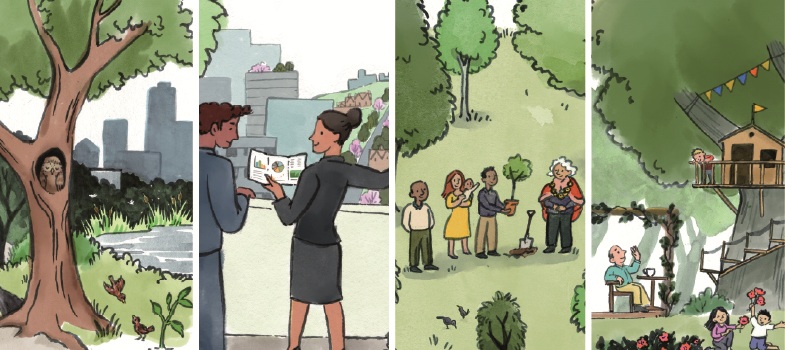
Example applications (2)
- procurement, asset management and financial functions
- planning, design guidance, housing and streetscapes
- transport and environment
In procurement, asset management and financial functions, Tree Value Visions can suggest outcomes or processes, whether for inclusion in social value procurement or as goods and services in their own right. Tree Value Visions outcomes could be used to shape consultation with businesses and supply chains, development of social value awarding questions, and Key Performance Indicators (KPIs). Tree Value Visions does not supply numerical financial values analogous to capital asset values or monetised ecosystem service values, but it can support qualitatively identifying assets with existing or potential social and cultural value, based upon their biophysical characteristics and human factors. Doing so could inform decisions around their prioritisation, investment, or protection. The method would incorporate trees as assets, but also aligned assets affecting human factors and use, such as access rights and location (street trees, rear private-gardens, parkland etc.), or secondary assets such as paths, planters, benches etc.
For planning, design guidance, housing and streetscapes, Tree Value Visions can inform statements of character incorporated into Local Plans, conservation areas, etc. The methodology provides a standardised means of holistically assessing social and cultural values, supporting both systematic and comprehensive outputs, which can be used to help develop and justify guidance and strategic decisions. It could support the inclusion of social and cultural value in proposed tree planting, replacement or management, in parallel to biodiversity net-gain and capital asset value compensation. The simplicity of the tool supports adaptation to follow on community involvement, such as voluntary tree warden verification of whether developer commitments have been delivered.
Transport and environment functions could be informed, and beyond ‘the view from the vehicle’, Tree Value Visions particularly aligns with healthy streets and waste collection agendas. Walking, cycling and wheeling are addressed by making streets and paths more amenable. Tree Value Visions supports the policy integration of active travel with treescape planning and management, including incentivising public transport through an improved environment during feeder journeys and waiting at bus or tram stops. Addressing private motor vehicle use, support for low-traffic neighbourhoods or reduced mowing of grass verges could be influenced by inclusion of new planting or altered maintenance, and the attendant social and cultural value. Impact upon bin collections, both domestic garden and organic waste, and indirectly upon regular collections, could be evaluated.