Decision Making and Management Responsibility
The key feature to note here is that the actions incorporate authority and activity. They go beyond deciding the relative primacy of communities, experts and markets. In panel discussion, the ranked importance of each group might be settled relatively quickly, but understanding can be furthered by discussion of what they might (or might not) be expected to do.
|
|
Mentioned by Living … |
||||
|
DECISION MAKING AND MANAGEMENT RESPONSIBILITY |
Description |
In |
From |
With |
As |
|
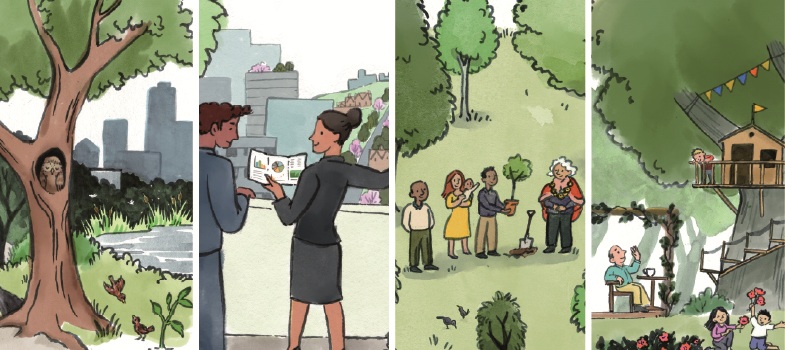
Local communities play a central role in making decisions. There is extensive public participation in designing the future of the treescape and extensive volunteering in the upkeep of trees and green spaces. |
x |
|
|
x |
|
Ecological experts play a central role in decisions, with more limited participation for local communities.
|
|
|
x |
|
|
Companies and investors play a central role in deciding what the treescape is for. Expansion and maintenance of the treescape is oriented towards business, whether through schemes like carbon markets and biodiversity banking, or increasing commercial benefits such as increasing visitor numbers by planting trees along high streets. |
|
x |
|
|
Notes
This set of actions is primarily about what expertise is relied on, but also to some degree considers whether participants are open to a more top-down, a more grassroots, or a more market-based approach. The shorthand could be: grassroots participatory expertise, professional external expertise, commercial expertise.
Under professional tree experts, this is about genuine expertise and training in tree-related matters – e.g., tree officers, arboriculturalists, and ecologists. It is not intended to prioritise sub-groups, such as prioritising ecological surveyors over tree officers.