Social and Legal Actions
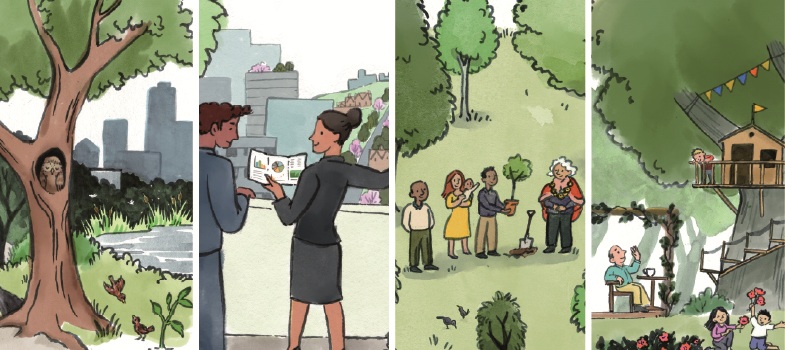
The social and legal actions start with a human factor, which is then met via changes to the treescape, which is the reverse of the physical actions.
|
|
Mentioned by Living … |
||||
|
SOCIAL AND LEGAL ACTIONS |
Description |
In |
From |
With |
As |
|
The local authority has an obligation and plan to ensure access to half a football pitch (0.5ha) of greenspace (including trees) within a five-minute walk (200m) of every home. |
x |
|
|
|
|
NHS trusts/health boards enact policies that encourage and support GPs to prescribe participation in outside activities for preventative and restorative mental and physical health. NHS and care sector develop policies to ensure accessible green spaces at care facilities wherever possible. |
|
|
|
x |
|
Local charities (e.g. environment, health, aging, disability etc.) expand their range of, and shift their focus to outdoor therapeutically oriented activities. |
|
|
|
x |
|
Local councils work with environmental charities to make a tree available for planting in a garden or public place, for every child born. |
|
|
|
x |
|
Connection with nature becomes a central element of all child-related policies and becomes a central element of the curriculum, such as through forest schools in every primary school and bushcraft in every secondary school. |
|
|
|
x |
|
Trees receive a legal right to be represented in decision making and court, supported by a register of volunteer citizen guardians. |
|
|
|
x |
|
Local government, businesses, and arts and culture organisations work together on a development plan to better harness and develop greenspaces and trees for economic opportunities (e.g. tourism, hospitality, media, outdoor performance) |
x |
|
|
|
|
Veteran (very old) and culturally significant (e.g. memorial) trees are protected from development. |
x |
|
|
|
|
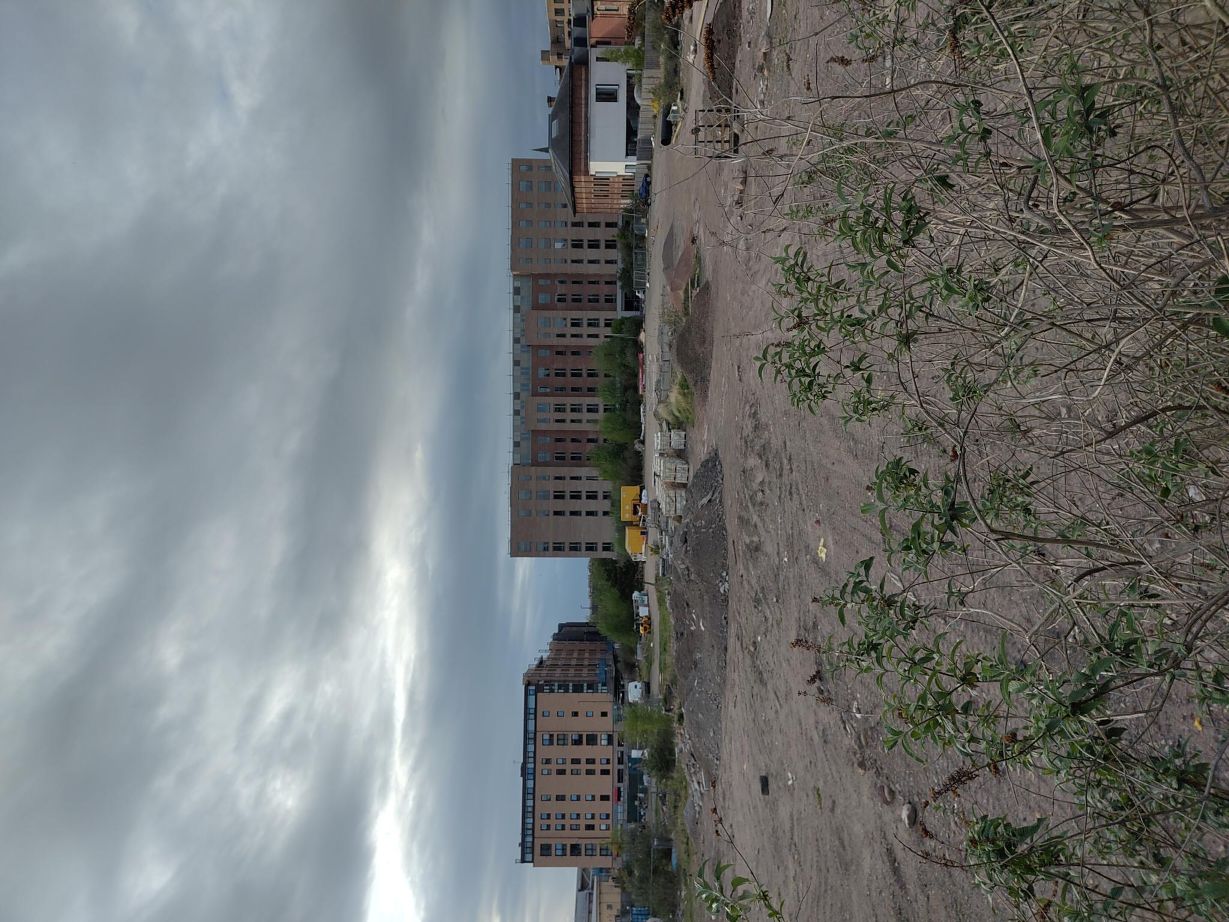
9. New developments have biodiversity as a hard constraint
|
Developments are not allowed to have a significant negative impact on local biodiversity (the diversity of habitats and species present) or rare or threatened wildlife. This means developments generally only take place on brownfield or low-biodiversity agricultural land. |
|
|
x |
|
|
10. Biodiversity loss by developments can be compensated elsewhere
|
Developments are allowed to have a significant negative impact on local biodiversity (the diversity of habitats and species present), but the impacts must be compensated by creating extra nature elsewhere (for example, on lower cost land further away from the city). |
|
x |
|
|
In the 'right to access...' action, the substantive point is for the greenspace to be accessible, significantly bigger than most private gardens, and not satisfied by roadside verges or individual planters. It does not require the space to be a woodland, and could be satisfied by a park or public or communal garden with trees in it. The specific figures of 0.5ha and 200m are derived from the 'Access to green space in England' official statistics, as this links the tool to existing datasets.
As previously, authorities with significant rural land would experience these actions very differently to those in the centre of a larger built-up area. The amount of brownfield land in the area will further affect the terms of debate. Only the 'Right to access...' action has restricted, prescriptive locational implications.