Example Users
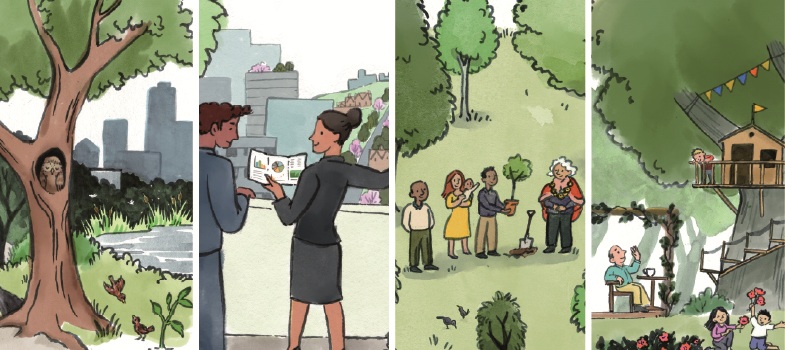
For local authority officers, Tree Value Visions can be used to identify and build community support for policy and management priorities. It supports knowledge exchange and helps identify opportunities for consensus building, synergies, and trade-offs across sectors and specialisms. In so doing, it can be used as a pre-consultation tool or to inform policy development or appraisal, helping to ensure that individual policies are aligned with long term strategic visions, and thereby feeding into better informed decision-making.
For elected representatives, the deliberative tool complements representational democracy and ongoing community engagement or casework. Overall, it supports a greater range of views, stakeholders and demographics to be engaged with. The methods use everyday language, discussion, storytelling and map-drawing, and do not require prior knowledge of policy vocabulary or technical knowledge. It provides a low-resource method to identify risk, support or opposition linked to treescapes.
For community groups, third sector or private organisations, Tree Value Visions can be used to identify priorities that align with organisational goals. It can gather evidence that broadens the conversation around local treescape management beyond the relatively narrow sets of values and indicators associated with statutory duties. Moreover, Tree Value Visions can be used for building alliances between different interests e.g. linking environmental interests to health and wellbeing, or specific interests of particular social groups (e.g. youth, disabled people). In some cases, the implications could be direct, for example, for informing the design of significantly sized housing developments by private developers. Alternatively, a charitable organisation might use the tool to steer its priorities, subsequently deciding between what it could deliver directly and what would need to be achieved by influencing others. For example, to decide between giving away free trees or campaigning for the local authority to require a certain level of canopy cover in new developments.