Example applications (3)
- economic development
- health and wellbeing
- children and young people
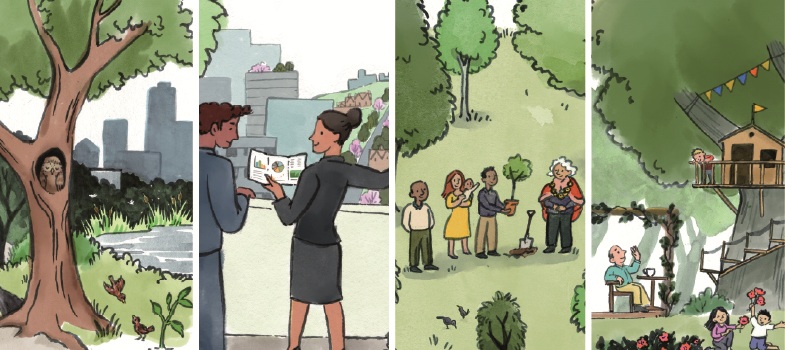
In economic development, the identified or potential value could support targeted actions to preserve or provide increased treescape amenity. Doing so could support the local labour market or attract investment, including high streets’ placemaking to increase consumer spending or the number and length of visits. Similarly, it could inform forms of planting, maintenance, non-tree assets and human uses that support strategic aims, such as encouraging city centre residency or brownfield redevelopment. It might also address Community Wealth Building and local job creation, as treescape planting and maintenance requires expenditure on service-provision in place.
Addressing health and wellbeing, or the wider determinants of health, Tree Value Visions can identify forms and locations of treescapes garnering support for, and from, healthy environments or activities. Whilst green spaces are quite commonly assumed to have health and wellbeing benefits, whether through pollution control or supporting exercise and attention restoration, Tree Value Visions can inform the design of treescapes conducive to local social and cultural forms and value. These might be intensively focused on medical and health institutions (and stakeholders) or applied more widely in seeking to create pro-wellbeing urban environments. This might span from (elements of) local exercise facilities being created as outdoor and ‘green’ gyms enabling local social and cultural (and sporting) forms. It could support the creation and maintenance of treescapes that design-out cultural or social elements seen as exclusionary, and design-in cultural or social elements encouraging widening participation in exercise, respite and rest opportunities, or the maintenance of activity and independent living in older age or debilitating conditions.
For children and young people, the tool’s everyday language and straightforward methods are suitable for their direct inclusion. Tree Value Visions can be used by citizen panels that include youth representatives, or directly with youth groups to identify their treescape value priorities. Tree Value Visions includes key elements that focus on outdoor education and engagement in terms of connection to nature, and Tree Value Visions could be used to inform the design of school environments. For children with disabilities, medical needs, or children in the care system, the tool could be used to identify measures for improving the experience of facilities and homes and their surrounding areas.