Purposes and benefits of using Tree Value Visions
The tool gives users a capability to rapidly identify actions that would enhance the value of, and the value derived from, an area’s trees. It achieves a rich picture of priority values without the need for elaborate bespoke primary qualitative data gathering. The full tool is designed for application in contexts of limited discretionary spending by local authorities, and the proposed actions suggested are, in many cases, financially neutral. The tool can develop packages of actions for multi-stakeholder implementation, bundled to provide positive-sum relationships and/or resource-efficient ‘total place’ approaches10, underpinned by shared learning.
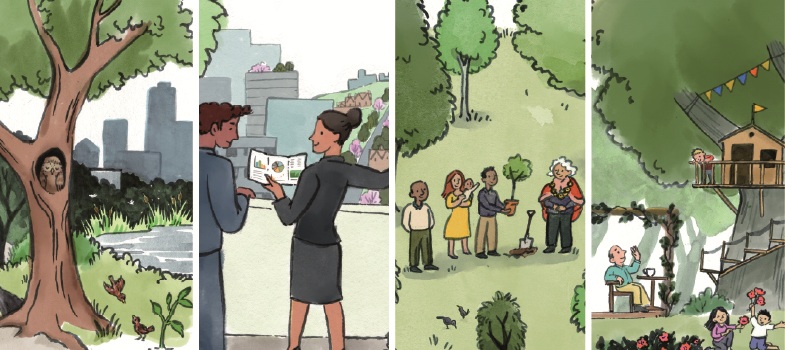
The future visions are intended to be inspirational, so their differences are clear and they can function as discussion prompts. The participatory method involves several rapid stages that seek to generate consensus around aspirations to identify potential areas of consensus that can be prioritised by follow-on actions. For example, the tool might identify unexpected support for the planting of trees in a particularly culturally resonant way (e.g. dockside revitalisation), which could then be prioritised.
In supporting assessment, some ‘life frames’ (living in, with, from, or as) can have a particular resonance with particular policy areas. For example, placemaking has clear links to the ‘living in’ frame, and biodiversity to ‘living with’. However, the tool is designed to prompt holistic analysis across an extensive range of factors, whilst it uses elicitation of a set of broad values to draw together individual issues or uses.
Operating the tool can support participatory democracy and public engagement aims. Because existing tools do not generally address social and cultural values, Tree Value Visions can suggest options for securing additional social and cultural value through adaptations to existing processes (e.g. management of existing trees). It can also be used defensively, to protect previously unrecognised value (e.g. in town planning). The tool can inform, justify or direct additional investment by identifying beneficial value outcomes of, and public support for, actions across multiple policy areas (e.g. health and wellbeing, heritage, carbon, biodiversity, flood resilience, education and children, recreation and tourism, housing, transport). The tool can also support cost savings, for example by identifying forms or locations of mixed woodland and wildflower meadows that might secure greater public support, thereby reducing mowing of grass parkland or verges. In its outputs, the tool thus goes beyond a basic focus on ‘more trees’, to suggest more nuanced ways to maximise social and cultural values.
Influencing the development of strategy, policy and delivery, the tool is likely to be most suited to pre-consultation engagement stages. It has a small sample size and, comparable to a focus group, can be used to prompt conversations with residents and other stakeholders that open up their views. The materials (visions, outcomes, actions) form a set of ‘provocations’ that support participants to suggest localised, prioritised values and ways of delivering on those values. The tool is designed to identify areas of potential consensus and plurality support in the long term. This contrasts with a focus group, which is traditionally designed to maximise diversity in order to uncover ‘unknown surprises’ (rather than prioritisation or popularity), and currently held views. The outcomes of the panel are often suited for integration into longer-term processes to replicate that consensus outside the panel, such as by enrolling stakeholders or building a coalition in support of a local proposal. A potential add-on to the tool, which we are scoping, is to develop a template ‘follow-up survey’ to evaluate the level and type of support for the panel’s proposals.