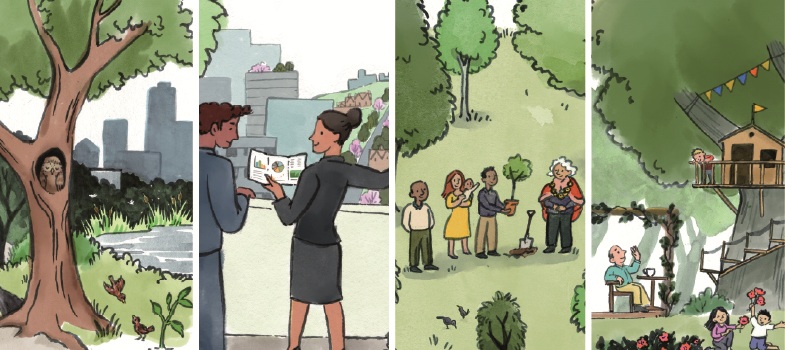
Possible outcomes of future visions - Nature and Environment
|
Nature and environment |
||
|
There are more plants and animals in the city.
|
All |
|
Species that are rare and threatened have more access to suitable habitat and food, and are better protected.
|
Living with |
|
People and wildlife are better protected from the effects of climate change, including extreme weather such as heatwaves, droughts, extreme rainfall and floods.
|
Living with |
|
Air and water quality is better regulated by trees, with pollution reduced.
|
Living with |
|
People better understand trees, nature and greenspaces, and their values. |
Living as |
Notes
A key consideration is to balance consideration of general principles against specific principles or technical knowledge that participants might bring. For example, whether 'endangered' is considered generally ('extinction is bad') or technically (a specific local species' habitat requirements). This has implications for whether protections are prioritised as 'generally stronger' or become focused on more specific mechanisms later in the workshop, such as green corridors. If participants explicitly seek to narrow the conversation this is valid, such as seeking to conserve a locally emblematic species, but facilitators should be wary of more technically-knowledgeable participants being seen as more authoritative and so being allowed to lead the conversation as 'experts' rather than 'equals'. Similarly, sensitivity can be needed in discussions as to whether education about trees is seen as an intrinsic good or a means towards other outcomes.