3 Paired reading
Reading together can be more beneficial than reading alone, and it can also be fun.
Paired reading offers a supportive, collaborative learning structure that is ideal when one student is not as confident a reader as the other. Students can be very capable and sensitive ‘teachers’ of each other. Read Resource 1, ‘Using pair work’, to learn more about organising your students in this way.

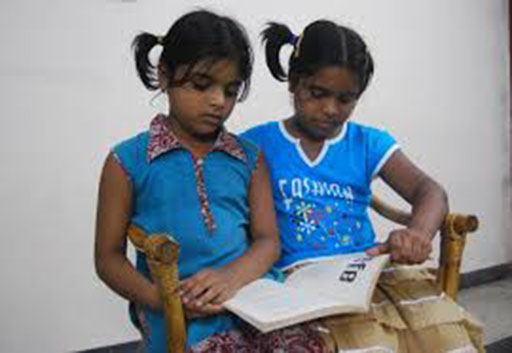
With paired reading, two students share a book and take turns to read a sentence, paragraph, or page (Figure 3). The first reader reads while the second reader listens and follows along. The second reader then continues from where the first reader stops. If one of them is struggling or makes an error, their partner can support or correct them.
You may choose to pair students of similar reading ability, or more fluent readers with less fluent readers, or older students with younger students in the case of a multi-grade classroom. If well organised, paired reading can be used with large numbers of students.
Now read the case study of a teacher who recognises the benefits of paired reading for bilingual students.
Case Study 3: Pair work for bilingual reading support
Mr Roy teaches Class V in a rural school in Madhya Pradesh.
Some of my students speak Rathwi Bareli (from the Bili group of languages) as their home language. They have made steady progress in understanding and speaking Hindi at school, but lack confidence in reading aloud. I noticed how one of my students, Surumi, used to look at books in the classroom. She seemed to be absorbed by the pictures but she did not appear understand the words on the page.
One day, I sat down beside her as she was looking at a book and asked her what the story was about. She understood my question, but found it difficult to answer. I therefore read part the book to her while pointing to the words and pictures. I asked her some simple questions and she answered in a mixture of Rathwi Bareli and Hindi.
I had the idea of asking an older student who spoke Rathwi Bareli and Hindi to read the book to Surumi. As he did so, he explained the meaning in her home language. Surumi listened attentively and responded to his questions in a mixture of Rathwi Bareli and Hindi.
I looked for other books with attractive pictures that I thought Surumi might enjoy. I found one that included well-known folk tales and a simple reader with repeating phrases. I asked a colleague to translate the stories into Rathwi Bareli so that Surumi could see them written both in Hindi and her home language. Gradually, Surumi became more familiar with Hindi and could understand more and more of these books. She is now reading slightly more difficult books with longer sentences. It has been very satisfying to observe her progress.
 Pause for thought
|
We live in a diverse, multilingual society where all of our languages are valuable resources. Encouraging your students to use their home languages can help them feel confident and comfortable at school, and can help them improve their Hindi. Even if you don’t speak the same home languages as all of your students, there may be some students in the school who can help others. Students who speak the same home language can be encouraged to read in pairs or small groups. In this way they can help one another by using their home language to support the development of the school language.
The next activity is designed to help you incorporate using paired reading in your classroom.
Activity 3: Introducing and organising paired reading
This activity can be done in pairs or in small groups of three or four. Decide in advance which students you wish to pair or group together. Will they be matched by the same or differing abilities? Choose what the students are going to read, making sure you have sufficient copies of the text.
Start by modelling paired reading so that your students know what you expect them to do. Show the students the book – or the passage – that they are going to read and choose one of them to come up and be your partner. Explain that you will start by reading a paragraph aloud together and then take turns to continue reading. Start by reading the first paragraph together. Then let the student continue reading the next one. Change over and read the subsequent one yourself. Take turns several times.
Choose another student to pair up with the first one and let them demonstrate how to do paired reading together. If you plan to have larger groups, ask a third or fourth student to join in.
Tell your students that, if their partner or group member is having difficulty, they should wait a few seconds before helping them, to give them the opportunity to resolve the problem. Explain that it is better to provide the student with a clue – such as the first sound of a word – rather than the whole answer.
Initially, paired reading should last a total of ten minutes, building up to a maximum of 30 minutes as your students get used to this activity. Encourage your students to read aloud using quiet voices so as not to disturb their classmates.
Move around the class and listen carefully to check that your students have understood the activity. Give support to those who find reading difficult. Keep a note of which students have worked together, observing how well they do. While some individuals may be particularly suited to working with each other, it can also be helpful to vary pairings or groupings from time to time.
After the activity, ask your students whether they enjoyed the activity and found it useful. Praise them for helping each other. You can follow up the paired reading with a brief book talk session about the text.
2 Book talk